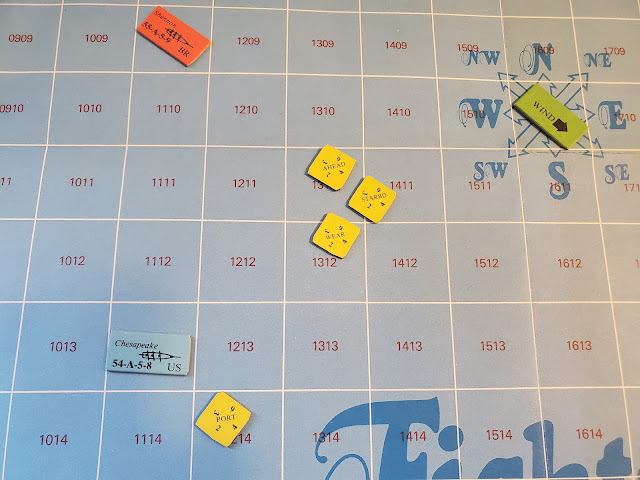
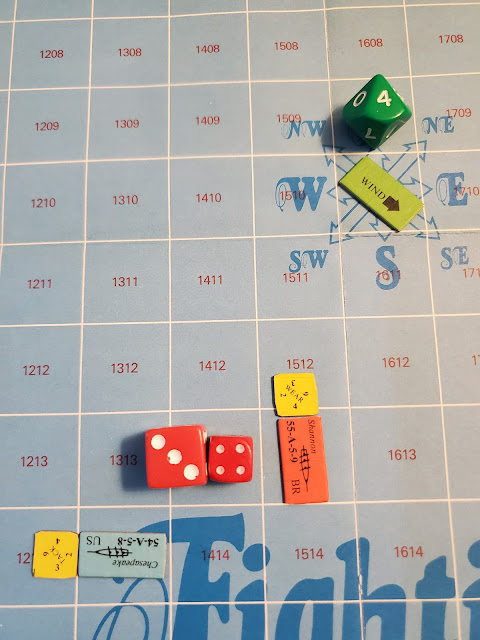
"I fear we have awakened a sleeping wargamer..."

"...and filled him with a terrible resolve!"
from: [click]
Well, at least a terrible resolve to play a lot more WWII fast-play naval games!
With building excitement for my periodic naval wargames projects, I redid my fast-play WWII naval rules previously posted [CLICK] in the distinct style of One-Hour Wargames. I used the 6-Hits and 3-dice mechanics, which are very similar but give less attritional outcomes [ie you can totally miss] as naval battles in this era are focused more on gunnery than attriting your opponent, and well, you really can miss completely in naval gunnery!
Mr. Winkie is getting to be a young man, so I will have to see if I can convince him to play this out on the table so for now this version has NOT been playtested! You have been warned... Do submit questions and ideas below, as Fb is well, evil, and a pain to track things on.
These rules are focused on ship fighting, but give some - reasonable, I believe - nods to subs and airpower, which on most occasions were supporting the ship effort in a surface battle. My main thinking has been the USN v. IJN in mid-war, and perhaps the RN v. the RA in the Mediterranean, circa 1940-1942. You can tweak these to be a bit more specific as you like, and please send me your ideas!
Without further ado:
One-Hour WW2 Naval Warfare
By Alexander A. Moore of RED IN THE MORNING...
SCALE
This is not very NT/OHW to define, but the scale is a 6 minute turn, 1”=1,000 yards. This works out to 5 knots of speed is 1” for example, and 2” is a nautical mile [nm].
SHIP TYPES
Battleship BB, Cruiser CA, Destroyer DD, Submarine SS.
Force Composition is using the regular charts substituting as follows:
Basing should be about ½“ - 1” wide and long enough to give ½” of space front and back. Put the naval flag, class and name of the ship on the base!
TURN SEQUENCE
The Attacker takes the first Player Turn, the Defender then takes a Player Turn. This ends one Game Turn. Each Player Turn is composed of the following Phases:
Movement. Player sequentially moves all his ships.
MOVEMENT
Turns. Ships can turn up to 90° at the start
and/or end of the move as indicated.
TERRAIN
The terrain features in the OHW scenarios must be adjusted for nautical warfare as follows:
Woods = Fog/Squall. Half move speed, Range within is 2” @ -1d6 to all Fire.
Town, Hill = Island. No ship movement into area; blocks Line of Sight.
Marsh, Lake = Shallows. Only Small ships may enter, or none at all as seems best.
Rivers = Peninsulas, Reefs and Sandbars [take your pick[ which count as impassible terrain.
Bridge, Ford = Channel thru Peninsulas 2-3” wide; may be passed by all ships.
Roads = Remove from scenario.
By Alexander A. Moore of RED IN THE MORNING...
SCALE
This is not very NT/OHW to define, but the scale is a 6 minute turn, 1”=1,000 yards. This works out to 5 knots of speed is 1” for example, and 2” is a nautical mile [nm].
SHIP TYPES
Battleship BB, Cruiser CA, Destroyer DD, Submarine SS.
Force Composition is using the regular charts substituting as follows:
Basing should be about ½“ - 1” wide and long enough to give ½” of space front and back. Put the naval flag, class and name of the ship on the base!
TURN SEQUENCE
The Attacker takes the first Player Turn, the Defender then takes a Player Turn. This ends one Game Turn. Each Player Turn is composed of the following Phases:
Movement. Player sequentially moves all his ships.
MOVEMENT
|
Ship Type |
Movement |
Turns |
Turn at |
|
Battleship |
4” |
90° |
End of Move |
|
Cruiser |
5” |
90° |
End of Move |
|
Destroyer |
6” |
90° |
Start and/or End of Move |
|
Submarine |
4” / *2” |
90° |
Start and/or End of Move. *Submerged
Movement. |
TERRAIN
The terrain features in the OHW scenarios must be adjusted for nautical warfare as follows:
Woods = Fog/Squall. Half move speed, Range within is 2” @ -1d6 to all Fire.
Town, Hill = Island. No ship movement into area; blocks Line of Sight.
Marsh, Lake = Shallows. Only Small ships may enter, or none at all as seems best.
Rivers = Peninsulas, Reefs and Sandbars [take your pick[ which count as impassible terrain.
Bridge, Ford = Channel thru Peninsulas 2-3” wide; may be passed by all ships.
Roads = Remove from scenario.
FIRING
The arcs of Gun Fire are 45°off the front, rear and right and left sides. Measure between closest points of a base, or the closest smoke stacks. Roll 3d6 scoring Hits as below:
Adjudicate
Hits
If target is Small or Armored, lose 1d6 for each.
If at half range or less, add 1d6. If Firing out to an additional 6”, lose 1d6.
Gun Fire through Firer’s Front or Rear arc, lose 1d6.
Ship Torpedoes are only fired through the Side Arcs; Submarine torpedoes thru the Front Arc.
Ship Damage and Sinking
Each ship can take 6 hits, after which they are Sinking. Roll a d6 for Sinking ships each Turn:
1-2 ship stays afloat, 3-4 ship catches Fire obscuring like Smoke, 5 quietly sinks, 6 explodes! Attach all ships within 1” with 3d6 @ 5+, become 3”x3” burning oil slick obscuring as Smoke.
Suggestions for Scenario Rules
Fortified Islands. If scenario has a Fort, e.g. #15 or 22, the island may have shore batteries, which count as Armored ships with 12” Range, Firing 3d6 @ 4+ to Hit. These are assumed to be scattered around the island, so draw Range and Line of sight from any point. Alternately, base them on two DD bases, and actually deploy them on the island, then draw Range and LoS from them at 180°.
Optional Rules
Submarines
Only the Defender may have a Submarine, which is exchanged for a CA.
Arc of Fire. Submarine torpedoes fire out of the Front Arc; its Gun fires into any arc.
Aircover. If one force has BBs and the other has fewer, Aircover is available to the force with fewer and attacks on Turn 1, or the first turn an opposing BB is on the table. Airpower attacks 1-3 Targets [1/2 d6 round up] and each target gets one air attack. The value of the attack is:
3d6 @ 4+ to Hit if one force has two BB and the other one.
Air attacks get +1 d6 if attacking a Large ship or Island.
Battleships attract significant opposing resources as impressive targets!
National Characteristics for Torpedoes
IJN Type 93 “Long Lance”: 12” Range, 3d6 @ 3+ to Hit. Cruisers may have torpedoes!
USA Mark 14 Torpedo: 6” Range, 3d6 @ 5+ to Hit
If using this rule, it is advised that the USN force get Aircover.
Torpedo Hits result in the loss of 1d6” of of movement each – halve for Armored ships. Once all movement is lost, the ship is Stationary. If using this rule, switch all Torpedoes to 2d6 instead of 3d6.
Island defense. In scenarios with a town that has no Fort, the defender may exchange one CA to give the Island a Shore Battery as above.
Two Targets. Most BB and CA in this period had two Fire Direction Centers and could handle two Targets. Accordingly, 1 dice may be fired at one Target, and two dice at another target. Each Fire is then modified according to the circumstances.
Target Acquisition. Ships generally picked a target and stuck with it until it was out of the fight. This is because acquiring a new target was difficult and took time and skill. One way to handle it is to penalize a ship -1d6 if it has started firing upon a Target this Turn. Another way to handle it is to give +1d6 for “Fired upon the same target as last turn”. If the Target moves out of Line of Sight, the acquisition is lost and the penalty is applied again. I prefer the -1d6!
Smoke. Many ships could lay smoke as an obscurant to enemy Fire. Smoke is a linear terrain feature along the path the laying ship took this turn. If a Target is completely on the other side [ship model or entire base, as you prefer] of the smoke, all Fire at it is -1d6. A black pipe cleaner is perfect smoke!
Variable obscurants. Fog, Squalls and even chemical smoke laid by ships can be quite variable, largely depending on the effect of wind. It is therefore more realistic to have a ship decide on a Target that is obscured by these and roll 1d6 for the number of inches to the Target that it can see. If it fails to roll enough inches, the Target can’t be fired upon. Alternately, subtract another 1d6 from its Fire – it’s your scenario!
Minefields. Some setups may need an obstruction that attacks, e.g. Scenario #6 Zone 1. For the cost of a CA, the setup area has a minefield that attacks any ship moving through it once a movement phase at 3d6 @ 3+ to hit.
Hit the Beach! Some scenarios seem to demand that a Town/Hill be seized, not their batteries merely silenced – consequently, the Island must be invaded! If both players agree, the defense gets a Shore Battery, and the Attacker may substitute Transports for 1-2 Destroyers [or 2 for a Cruiser]. The Transports may attack the island with a landing force which has a range of 2” and attacks at 3d6 @ 4+ to Hit. If the Shore Battery is based, then the landing Force advances up to 1” a Turn and attacks on contact, per the Melee rules! Neither side may shoot into a melee.
Night. The IJN made huge efforts to prepare for it, and even early radar didn’t improve USN performance much. The best one can say is it enabled a sort of parity for a while, until the USN improved both the tech and the technique of radar fighting. Easiest is to limit ranges to 6” or three nautical miles on a moonlit night, using one marker per ship until they are at that range. You could shorten it to 3” even for a new moon. Expect the fight to be short and violent! For variable visibility, roll a d6 and add it to the Range you set each time a ship Fires at a Target – if it falls short the target is out of Line of Sight. Ships that fire always replace their marker. For flares, Fire them at the start of the Fire Phase, make visibility 6” or 3” around the flare depending on the moon. Ships that do not Fire and are not illuminated or within Line of Sight may become markers again – markers cannot be Fired upon.
Traditional OHW Fire Dice. You can return the Fire mechanics to the OHW by giving the ships firing at 3+ the d6+2, the 4+ the d6, and the 5+ the d6-2, and all ships get 15 Hits. But why?? 😊
The arcs of Gun Fire are 45°off the front, rear and right and left sides. Measure between closest points of a base, or the closest smoke stacks. Roll 3d6 scoring Hits as below:
|
Ship Type |
Range |
Hit on |
Armored |
Size |
Torpedo |
Notes |
|
Battleship |
18” |
3+ |
Yes |
L |
N |
|
|
Cruiser |
12” |
4+ |
|
M |
N |
|
|
Destroyer |
6” |
5+ |
|
S |
Y |
Torpedo: 6” Range, 3d6 @ 4+ to Hit. |
|
Submarine |
6” |
6+ |
|
S |
Y |
|
|
Shore Battery |
12” |
4+ |
Yes |
L |
N |
|
If target is Small or Armored, lose 1d6 for each.
If at half range or less, add 1d6. If Firing out to an additional 6”, lose 1d6.
Gun Fire through Firer’s Front or Rear arc, lose 1d6.
Ship Torpedoes are only fired through the Side Arcs; Submarine torpedoes thru the Front Arc.
Ship Damage and Sinking
Each ship can take 6 hits, after which they are Sinking. Roll a d6 for Sinking ships each Turn:
1-2 ship stays afloat, 3-4 ship catches Fire obscuring like Smoke, 5 quietly sinks, 6 explodes! Attach all ships within 1” with 3d6 @ 5+, become 3”x3” burning oil slick obscuring as Smoke.
Suggestions for Scenario Rules
Fortified Islands. If scenario has a Fort, e.g. #15 or 22, the island may have shore batteries, which count as Armored ships with 12” Range, Firing 3d6 @ 4+ to Hit. These are assumed to be scattered around the island, so draw Range and Line of sight from any point. Alternately, base them on two DD bases, and actually deploy them on the island, then draw Range and LoS from them at 180°.
Optional Rules
Submarines
Only the Defender may have a Submarine, which is exchanged for a CA.
Arc of Fire. Submarine torpedoes fire out of the Front Arc; its Gun fires into any arc.
Aircover. If one force has BBs and the other has fewer, Aircover is available to the force with fewer and attacks on Turn 1, or the first turn an opposing BB is on the table. Airpower attacks 1-3 Targets [1/2 d6 round up] and each target gets one air attack. The value of the attack is:
3d6 @ 4+ to Hit if one force has two BB and the other one.
Air attacks get +1 d6 if attacking a Large ship or Island.
Battleships attract significant opposing resources as impressive targets!
National Characteristics for Torpedoes
IJN Type 93 “Long Lance”: 12” Range, 3d6 @ 3+ to Hit. Cruisers may have torpedoes!
USA Mark 14 Torpedo: 6” Range, 3d6 @ 5+ to Hit
If using this rule, it is advised that the USN force get Aircover.
Torpedo Hits result in the loss of 1d6” of of movement each – halve for Armored ships. Once all movement is lost, the ship is Stationary. If using this rule, switch all Torpedoes to 2d6 instead of 3d6.
Island defense. In scenarios with a town that has no Fort, the defender may exchange one CA to give the Island a Shore Battery as above.
Two Targets. Most BB and CA in this period had two Fire Direction Centers and could handle two Targets. Accordingly, 1 dice may be fired at one Target, and two dice at another target. Each Fire is then modified according to the circumstances.
Target Acquisition. Ships generally picked a target and stuck with it until it was out of the fight. This is because acquiring a new target was difficult and took time and skill. One way to handle it is to penalize a ship -1d6 if it has started firing upon a Target this Turn. Another way to handle it is to give +1d6 for “Fired upon the same target as last turn”. If the Target moves out of Line of Sight, the acquisition is lost and the penalty is applied again. I prefer the -1d6!
Smoke. Many ships could lay smoke as an obscurant to enemy Fire. Smoke is a linear terrain feature along the path the laying ship took this turn. If a Target is completely on the other side [ship model or entire base, as you prefer] of the smoke, all Fire at it is -1d6. A black pipe cleaner is perfect smoke!
Variable obscurants. Fog, Squalls and even chemical smoke laid by ships can be quite variable, largely depending on the effect of wind. It is therefore more realistic to have a ship decide on a Target that is obscured by these and roll 1d6 for the number of inches to the Target that it can see. If it fails to roll enough inches, the Target can’t be fired upon. Alternately, subtract another 1d6 from its Fire – it’s your scenario!
Minefields. Some setups may need an obstruction that attacks, e.g. Scenario #6 Zone 1. For the cost of a CA, the setup area has a minefield that attacks any ship moving through it once a movement phase at 3d6 @ 3+ to hit.
Hit the Beach! Some scenarios seem to demand that a Town/Hill be seized, not their batteries merely silenced – consequently, the Island must be invaded! If both players agree, the defense gets a Shore Battery, and the Attacker may substitute Transports for 1-2 Destroyers [or 2 for a Cruiser]. The Transports may attack the island with a landing force which has a range of 2” and attacks at 3d6 @ 4+ to Hit. If the Shore Battery is based, then the landing Force advances up to 1” a Turn and attacks on contact, per the Melee rules! Neither side may shoot into a melee.
Night. The IJN made huge efforts to prepare for it, and even early radar didn’t improve USN performance much. The best one can say is it enabled a sort of parity for a while, until the USN improved both the tech and the technique of radar fighting. Easiest is to limit ranges to 6” or three nautical miles on a moonlit night, using one marker per ship until they are at that range. You could shorten it to 3” even for a new moon. Expect the fight to be short and violent! For variable visibility, roll a d6 and add it to the Range you set each time a ship Fires at a Target – if it falls short the target is out of Line of Sight. Ships that fire always replace their marker. For flares, Fire them at the start of the Fire Phase, make visibility 6” or 3” around the flare depending on the moon. Ships that do not Fire and are not illuminated or within Line of Sight may become markers again – markers cannot be Fired upon.
Traditional OHW Fire Dice. You can return the Fire mechanics to the OHW by giving the ships firing at 3+ the d6+2, the 4+ the d6, and the 5+ the d6-2, and all ships get 15 Hits. But why?? 😊