Showing posts with label WWI. Show all posts

Thursday, August 1, 2019

Ace of Aces - the miniature game

Hexes!? We don't need no stinkin' hexes!

https://boardgamegeek.com/image/517636/ace-aces-flying-machines

Over with the old club the other night, and had a great chance to get into some WWI flying ace action with the hosts miniatures adaption of his favorite WWI flying game, "Ace of Aces".  This was actually a flip-book *game* where the designers ingeniously hid the entire mechanics inside the book, and you picked a maneuver, turned to the page that corresponded to your opponent's maneuver, and a hand-dawn pic showed you what your situation was. An example of it is in the below image, from Wikipedia article [CLICK]


There is also a nice amount of info at Boardgame Geek [CLICK], including the market rate of the game in its various printings, etc. A really neat game, one of a rare breed, and I love the hand-drawn pics. May have to get it some day to play with my son while traveling by air, train, etc.

Anyway, the host's particular genius was to figure out the hex-based mechanics behind the flip-book maneuvers, then translate them onto the table. He took actual pics of the planes on tile hexes, marked the start/end positions with color, then printed them on cards, like the below:

Above, start position in yellow, end position in red.

By drawing the hex outlines on the table, we have the board, and the ways to maneuver [which is the main challenge]. Each turn, you pick a maneuver and put the card face-down on the table. When all have done so, the cards are flipped and the maneuvers are executed. Additional rules are quite simple, e.g. you can't shoot each other in the same hex.

Above, yet another near-miss. Beats being shot down, but I wish I had a pistol to take a shot as we fly by each other!


Above, brilliant maneuvering on my part has left my plane [left] once more in the sights of my opponent, "Death from Above" Matt. We started in the same hex, the one with the right card in it, and you can just tell how we moved out of the hex and our original facings by back-tracking the card.

Another too-often sight...our  planes jousting each other like the knights of the air we're supposed to be! We've just gunned each other a point-blank range for 2 hits each [planes have 6] and have revealed our cards:

...and below is the end result of the chosen maneuvers.


Another sight seen too often... we shot each other down. Sometimes it was the best I could do, however!


Game plays fast - the better you know you cards / maneuvers the faster it plays. Initially, we had a mutual shoot-down, then Matt crushed me three times quickly, then the 5th game I managed to win, and the 6th I crushed him. Overall, I'd still say it was more his game than mine, but I walked away with a bit of honor having learned a few of the key tactics I needed, and at least occasionally having the better second-guessing of his choice!

The game has no way to change your card once you've revealed them, and also doesn't use altitude. This does remove a couple of "reality" issues like pilot reflexes and the height advantage, but with 8 people playing you can only do so much in a 2-3 hour evening.

While Matt and I jousted, the other six were in an ugly scrum that was hard to follow, despite being just down the table.

Above, the Huns chase Limeys...
Below, jousting in pairs.


A wild mix of planes, I think there were a dozen, two per player. Sometimes it pays to get out of close proximity and get a little breathing space before charging again.


This could result in lots of damage, or lots of near-misses!


A fun time and a thoughtful game. Host likes the maneuvers and says that are quite historical despite the hex-mechanics. I am uncertain how much difference there is between planes, but Matt and I kept it simple by having identical performance and picking planes we like. So, not a beer'n pretzel game by being simplistic, but an easy fun time thanks to the simple mechanics and effort put into making them easy to work with...I wish more games and hosts did this!

Certainly has me thinking I should try Ace of Aces in its original form.

Thursday, May 30, 2019

WWI Torpedo Boat Tactics

This attack may look somewhat crazy...

...but it was successful! [link]

[Sorry for hiatus of several months! Have been pursuing Franco-Prussian War and a few other things, plus real life keeps getting in the way! But, have a couple of quick, interesting posts to make...]

Here are some great posts on WWI DD Tactics and Torpedo Runs, etc. Altho it may be between your interests, say Pre-Dreadnoughts and WWII, it should inform both discussions to some degree. After all, if they are having difficulty in WWI, they must be having more difficulties in 1898 or earlier, right?

Anyway, the info is from this TMP Post: 
http://theminiaturespage.com/boards/msg.mv?id=443552

I haven't found any good reference material for DD tactics in the first World War. Would they have attacked as a group? If so, would they have launched a massive number of torpedoes against a single ship or cluster of ships? If one out of five takes a rudder critical, or a bridge critical, would it just drop out and the remainder of the flotilla continue moving together?

Yellow Admiral: They did attack in swarms, by flotilla or half-flotilla. I don't think they had sufficient inter-ship C3 to concentrate torpedoes on a single ship in a line, but could almost certainly concentrate on a single ship alone (e.g. Warspite circling helplessly between battlelines…).

German and British DD captains certainly seemed to have the élan to press home attacks at great odds (not so sure about other navies), but real-life DDs tended to abort and retreat more often than gamers do. In WWI naval games, DD complements are frequently wiped out or reduced to paltry numbers, whereas in real life they tended to suffer some losses and then limp home. The morale rules in GQ3/FAI help defuse the suicidal devotion demanded by gamer admirals quite a bit, if the GM and/or players are paying attention.

There is this RN paper expressing an opinion on how DD should perform a torpedo attack
>>>It is therefore necessary, at long ranges, to take the whole of an enemy's line as the target, and, since the centre of spread should be near the point of aim, it is desirable to fire at the centre of the line. The spread of the torpedoes if a number are fired, may then be expected to cover a considerable area, and, provided the enemy are within range and maintain the same course and speed during the time of flight, not only the centre ship, but a part of the line on either side of the centre will be in danger, the length of line endangered depending on the actual spread of the torpedoes. Moreover, even if the enemy alters course after they are fired, he will probably not be able to keep entirely clear of the dangerous area unless he turns at least eight points, or, if at a range near to the extreme running range of the torpedoes, turns to such less extent as will admit of his ships outranging them. Nothing less than an eight point turn is likely to keep the whole line clear of their angular spread, but a smaller turn may suffice to take the line outside their range before the torpedoes can reach it.>>>>
gwpda.org/naval/nr191402.htm

+1 re Buckeye Bob's post. I have employed just such a minor (20-30deg?) turn away in war games to counter over-enthusiastic torpedo attacks launched at too distant a range. It's simple geometry and works as well on the table top as it did on the North Sea.
My books are still not fully unpacked, so can't cite chapter and verse, but my recollection of readings on WW1 DD tactics is as follows -

In tactical actions, the functions of the destroyers were two-fold: (a) to defend against any enemy torpedo attacks upon the battle line; (b) to attack the the enemy battle line should the opportunity present itself. Whereas the most dangerous torpedo attacks would originate from forward of the head of the battle line, friendly destroyer flotillas were typically positioned well ahead of the battle line on the disengaged side where their smoke would not interfere with gunnery; a certain proportion of destroyers (if available) would positioned at the rear of the battle line to provide protection in case of a course reversal by the battle line.
In a flotilla vs flotilla gunnery fight, British doctrine was to attack in line ahead and concentrate the gunfire by division upon a single enemy destroyer (preferably an opposing division leader) at an effective/decisive range within 3,000 yards or so in hope of quickly crippling it and disrupting the enemy division. The track chart of the destroyer action between Hipper's and Beatty's battle cruiser forces during the "Run to the South" will give an excellent nuts and bolts example.

Torpedo attacks against individual ship targets during daylight (for example, the torpedo attack made upon SEYDLITZ at Jutland) were very much the exception, rarely being undertaken unless said enemy ship was an isolated cripple. Torpedo attacks were intended to be delivered against the enemy battle line by a destroyer flotilla, whose respective divisions would successively launch their torpedoes en masse in a "browning" attack designed to fill with torpedoes a particular zone of ocean through which the enemy formation was projected to pass through. Hit expectations were based upon the relationship of number of torpedoes fired versus the number of enemy ships within the zone and the interval between them. 

British doctrine recommended that such attacks not close nearer than 5,000 yards, as any improvement in the odds of hitting was felt to be greatly outweighed by the increased risk of loss/damage from defensive fire.

The recommended approach to such an attack was from ahead and to windward on a reciprocal course to that of the enemy line, with launch point about 4 to 6 point off the enemy bow; this promised the maximum closure rate between attacker and defender, the shortest practical torpedo running time, the best net angle of attack for the torpedo vis-a-vis enemy base course, restricted the number of secondary guns and the length of time that they could be brought to bear upon the attacker, limited the evasive options open to the targeted line and provided the attacker an opportunity to rapidly disengage under cover of smoke. Simultaneous attacks upon both enemy bows ("anvil" attack) was extremely advantageous, but highly difficult to coordinate and carry out. Attacks from abaft the enemy's beam were highly discouraged, as they largely negated all the afore-mentioned advantages cited in connection with attack from ahead.

The number of torpedoes fired by each destroyer in such an attack depended upon the number of tubes that would bear and the number of torpedoes with the correct range/speed setting. WW1 era torpedo gyros were unreliable and imprecise; torpedo mounts were therefore typically trained over the side (broadly speaking – C/L mounts @ +/- 30deg of abeam on each side; Beam mounts @ +/- 60deg on that side) and fired only when the sight on the torpedo mount or director came onto the nominated target (say, the fourth ship in the enemy battle line). Torpedoes of WW1 were capable of multiple range/speed settings; generally and approximately speaking: 4,000 yds @ 45 kts; 10,000 yds @ 30 kts; 15,000+ yds @ 18-20 kts. However (IIRC) 

British destroyer torpedo settings had to be performed prior to being loaded into their deck mount tubes; settings could not be altered on the fly. Hence, to cover all tactical eventualities, a destroyer might carry two set for medium range, one for short range and one for extended range. Only torpedoes of the same setting could be effectively used in a given attack.

The results of such torpedo attacks in terms of actual hits upon the enemy were dramatically lower than pre-war predictions had suggested. There were several reasons for this. 
*First, the threat of mass torpedo attack was (quite rightly IMO) taken extremely seriously by all navies; even the appearance of an impending attack might well provoke evasive maneuver by the battle line. 
*Second, the technical performance of torpedoes (direction keeping, depth keeping, speed, charge fuzes) under actual war conditions proved considerably less efficient than theoretical pre-war assumptions. British 1916 estimates were that, for one reason or another, only about half of torpedoes launched actually arrived within the target's danger zone. 

That having been said, even an attack that scored zero hits might still yield benefit if it provoked the opponent to turn away at an important tactical moment. The multiple flotilla torpedo attack ordered by Scheer against the British battle line at Jutland scored no hits whatsoever but disordered the British as various ships were forced to evade oncoming torpedoes and compelled Jellicoe to turn his line away and, in the course of doing so, lose sight of Scheer's battle line at a vital moment.

Lots of typing here, LOL. Hope it proves of some interest and use.
Blutarski
**************************************************************
The only bit of Blutarski's post I'd differ from is this bit:
In tactical actions, the functions of the destroyers were two-fold: (a) to defend against any enemy torpedo attacks upon the battle line; (b) to attack the the enemy battle line should the opportunity present itself.
My impression is that this describes the British destroyer mission priorities, whereas the German priority was b/ over a/, which is supported to an extent by design differences observable between the two navies' ships (size, weapon type, etc). That said, this could be a gamer's over-simplification that I'm remembering.

Sailor Steve: I do remember reading somewhere, it may have been John Campbell's 'Jutland: An Analysis of the Fighting':  The Germans tended to go in line abreast, then do a group turn and all six fire one torpedo each, then turn again and run away line abreast. The British habit was to go in line astern. The lead boat would turn and fire, then the second, third etc.

The source I read noted that the Germans thought the British tactics were suicidal, whereas their own were much better.

Saturday, April 22, 2017

Brian DeWitt Naval Rules

"Czarist navy crosses globe, docks at sea bottom - news at 11!"


I did manage to reach Brian DeWitt, in a roundabout way through North Virginia Gamers, aka NOVAG where he's a Board Member. Through polite correspondence, we had the following interview, somewhat edited for clarity.

*********************************
Glad to hear you enjoyed the Pre-Dreadnought rules. There's no website for them.  I started selling them only by word of mouth because I had a lot of people asking for them.

Almost all the ship data is based on
Seakrieg 4th ship data (simplified however). The ship images are mostly from Janes Ships or Ship Blueprints webpage.


I sell the latest version of the rules and scenarios on a CD for $5.  I bring them to the HMGS conventions. There are 5 different sets:
A sailing ship set "Form on the Admirals Wake", Spanish American, Russo-Japanese, WWI and WWII. 

I can email the files if you do not attend the conventions and accept Paypal at my juno.com email address: 
brian.dewitt AT [etc] 

I make a lot of different games.  I emphasize playability as the most important factor but try and capture as much historical accuracy I can while maintaining the extremely high playability.  This is accomplished by using creative game mechanics and simple rules.

I enjoyed the article by Neil Thomas on "Simplicity in Practice" you sent me.

****************************
My club has enjoyed the Russo-Japanese set, called "When Dreadnoughts Ruled the Seas" which we play in 1/3000 on a 6x12' table. That being said, the actual engagement space was only about 6x4', so I think one can easily play out the approach moves - and play them faster - on paper. 

Altho the host said that they are more for fun and a "beer'n pretzel" set, I wouldn't say that is exactly true. I just think that he presents and plays them that way. Adding in weather and a few more decision points, and perhaps a bit of morale, and they'd gain significant depth.

So I can heartily recommend the pre-dreadnought set, at the very least, which I've now played 3 times in a large Russo-Japanese fleet context, and found it worked just fine. Most of the added complexity that would make it richer can just be scenario rules from an historical battle, anyway.

For further information, contact Brian!

Friday, April 14, 2017

Three Modern Naval Rule Sets: impressions and overviews

Why does this reality...


Play like this on the table?

I mean, my son is adorable and he won, and had fun, but...


I've three commercial sets of rules, all of which seem to have merit, and over which I've been thinking as to how to proceed with gaming some of my interests in the near future.

1. Naval Thunder: Clash of Dreadnoughts [WWI] & Battleship Row [WWII]

both are from Steel Dreadnought Games

2. Great War at SeaAvalanche Press WWI
Second World War at SeaAvalanche Press WWII

3. General Quarters 3 [WWII] & Fleet Action Imminent [WWI]
both are from Old Dominion Game Works Naval

Some first thoughts, for those of you new to modern Naval Gaming:
  1. Naval Warfare is highly technological - think WWII but ONLY tanks!
  2. This means that "historical" in context means totally respecting the differences in ships and gear that MAKE the tactics, or at least force them.
  3. It's really time-consuming and a labor of love to plow through all the details and math...let someone else with lots of time do it for you!
  4. Naval warfare is no more "line them up and blow stuff up" than any other type of wargaming is, or at least should be. However, it does have unique characteristics.
  5. Interestingly, Space Warfare is basically naval wargaming. Some more or less realistic than others. However, since it is a "notional" [military term] or "speculative" [literary term] world / universe, it is extremely important that the sci-fi universe closely copy the friction of technology prevalent in real naval wargaming, or it's just dull!
  6. ALL naval wargaming [and space warfare] is inherently strategic in nature, but not all land wargaming is.
  7. There is terrain in naval gaming but not all of it is land! There's also minefields, submarines and motor torpedo boats [all of which function to deprive admirals of movement, just like generals], but most especially there is weather!
So my warning is...don't think you can throw together a set of good naval wargame rules by yourself. It's a genre that really needs you to spend time in it. So commercial rules are - for most of us - far more essential than any land warfare period. The only related genre I think would be airplane combat, again, almost entirely dependent on technological differences to provide friction that makes for an interesting game, and what I don't know about flying and weather...well, it could sink a battleship!

So if you line up your armies of whatever period on a nearly empty table, slaughter away and then say it is dull, repetitive or lacks tactical finesse, that's the same thing as putting the fleets on the table without land, weather or other menaces to big ships, and then saying it is nothing but a dull exercise in gunnery - it may well be, but whose fault is it, anyway??

All this to say that if you love tanks, and wish the infantry would just go away, you will probably love naval gaming!

Impressions and overview of the rules.

The Naval Thunder series has certainly made quite the impression. Many say that it has put the fun back into naval gaming. It is cleanly written, with traditional mechanisms and easily "felt" mechanics that run along the "shoot, hit, penetrate armor, do damage, hope for critical" that many gamers love about naval warfare. It keeps all the additional stuff in the optional rules, from smoke to crew quality. The rules are easy to understand and altho the style is conversational it's not very distracting. That said, I personally prefer when the rule itself, that I actually need to play, is separated by bullet points or italics or something, and is easily found apart from the conversation and explanation.

Our first foray into it was a reply of the battle of Komandorsky Islands. It was pretty quick to pick up, but our use of the special rule for smoke exposed that some of the straightforwardness and simplicity that leaves the rules accessible and likable is at the expense of nuance and friction that can make some scenarios unplayable. In our battle, I quickly realized that I could use my destroyers to lay smoke and by turning at the end of the move hard back behind their own smoke, prevent even my own destroyers laying the smoke from being fired upon. While I'm sure that could have been done, it was awful easy to figure out and do, and rendered the IJN completely impotent, which it wasn't in the real battle. We needed a good hard wind, and some mechanism to prevent my ships from doing - exactly - what I wanted them to do.

While I think that it can certainly be dealt with using the odd special or scenario rule, and also that these rules are easy to tweak due to their simplicity, I have a problem with a basic mechanism being a "trump card" in any player's pocket.

All the rules in the series have excellent listings of ships and other info needed to play the game, as well as point values to help balance scenarios. I give these rules a solid "B" for their ability to make anyone a fan of naval gaming.

The Avalanche Press series has been a huge presence for many many years in the boardgaming industry. The series is huge, with 30-40 games and supplements in the two naval lines, not all of which are in print but most of which are available in the after market industry. All the core games come in boxes with lovely maps showing a strategic theater of operations and a tactical map upon which to fight out actions in more detail. They also come with basic and advanced tactical ship fighting rules, and thorough advanced rules from minelaying to airships to flotillas to submarines...you name it!

Game play resolved - very realistically - with fleets being given missions for which they then plot out their movement. Sometimes they have to plot out their entire foray at sea including the return to port! This strategic mission gives players a larger context in which to put their tactical fighting, and REALLY enhances the experience. The fleets then act out their movements, and when they get close enough have a chance to encounter one another and switch to the tactical map to blast away.

I have to admit I have not yet tried out these rules, nor followed through on plans to adapt them to tabletop miniature gaming. However, I am _slavering_ to do so! At the moment, I've 1898 [a pre-dreadnought game about the Spanish-American naval war], a few of the Jutland series games [WWI] and one WWII game, "Strike South". All look very manageable and are virtually an education in naval wargaming at all levels.

I have a lot of confidence in these rules due to their longevity, the thousands and thousands of copies sold, the clarity of the writing, the presentation of both the big strategic picture and a manageable presentation of the tactical fighting, and the breadth of situational rules that enhance the gaming experience. All the ships have detailed logs, as well as lovely top-down-view counters of the ships [altho they all show the ships to be the same length on the counter, from BB to CL, sort of a Wizards of the Coast scale problem]. The typical boxed game has hundreds of ships and their info handy on the counter and on sheets. 

[EDIT: this means you can wait on getting and painting up ship miniatures; the counters will not only do just fine but have all the info you need most printed right on them - they are 1"x1/2" for capital ships, and 1/2"x1/2" for small ships, however, this has to be balanced against the cost of these lovely games, which can go from $50-100 for a box, and $20-50 for book or bag presentation].

I'm giving these a solid "A-" for the full presentation of naval warfare in a manageable fashion, if without the tactical nuance that some players love. Most of the -minus- has to do with the cost - you can easily get several of the more playable naval games for $10-15, and if you go 1/4800 or 1/6000 escape for under $50 depending on the size of your fleets. OTOH, miniature naval rules usually don't have the tremendous breadth of a game like "Jutland" which has like 60 scenarios, every capital ship represented, and covers the English Channel to the Baltic.

Finally, near and dear to my heart, and played many, many times, is the "General Quarters 3" WWII game, and its companion "Fleet Action Imminent". Not for the faint of heart, yet not overwhelming in detail, this game really is an education in tactical naval fighting. You will learn all you gear, and you will learn it well, or you cannot hope to win a naval action in this game except through the errors of your opponents and the random favor of the dice. This was the game my pal offered after our speedbump with Naval Thunder: Battleship Row. I thought he was nuts! However, he really really really wanted to try it, so I gave it a real effort, and read the rules. Eventually, I found myself sucked in, sort of like reading a well-written astronomical treatise...you think it won't be interesting, or that it will be overwhelming, but eventually you find yourself devoting more and more time on it, and it is actually worth the time!

I was hooked, altho, interestingly, my pal moved on. I then read the rules a few more times, GM'd more games, read a lot of memoirs and decided that Guadalcanal was the perfect, ferocious naval encounter of the modern era. Rarely have so many expensive ships been so harshly used by so many admirals in such a short period of time! It's sort of like fighting about 7-8 battles of the Nile with a few Trafalgars thrown in. It's genuinely horrifying to watch destroyers clash with cruisers and battleships at point blank range, and to realize that you are now so close that you cannot evade a mildly competent torpedo attack.

I eventually settled on running 1/700 destroyer encounters I entitled "DDD - Deadly Destroyer Destruction" or something. I gave each player one ship, organized their squadrons historically, and gave each team three options for the approach, at night, into the "sea of battle". This meant there were nine possibilities in a scenario, so I could re-use them any time. Gamers loved it, and this has been my most-requested game to host.

The downside is that I never really convinced anyone else to read the rules. This meant I slowly became hoarse as we played a 4-5 hour game and I explained the detailed rule QRS and even the cheat sheets I made to speed things along. Even the ship diagrams and gunnery chart required some effort to understand. Once you got onto them, you realized how well they were thought out and play went pretty smoothly. Occasional oopsies on the GMs part were taken with good [enough] grace and we got through with quite a lot of fun.

Overall, these are the best set of manageable rules for tactical naval fights. I think they are a bit much for more than 1-2 ships a player, and even then I "slaved" the second ship behind the other one so that it was a mindless drone, giving the player the chance to keep playing even if one ship was lost.

We fought Savo Island, Cape Esperance, 2-3 Solomon Seas, and Kolombangara multiple times. Having invested many hours [and dollars] preparing the charts and QRS packets in color, I found it made a lot of sense to repeat most of the battles several times, perhaps with a little twist here and there, all based upon historical options. For some more details:
Savo Island AAR
Remember the 13th November!
Neither of which has pics of the actual ships on table, altho there are maps and other tools I use to throw the game. My excuse is that I still had a flip-fone, and kept forgetting to bring my digital camera with me. Mea culpa! My blogging has gotten a lot more colorful, but naval gamers aren't quite as interested in flashy looks as long as the charts are detailed, so maybe it's ok anyway.

There are a few campaign supplements for GQ3 / FAI. "Sudden Storm" is a speculative naval campaign for a 1937 naval confrontation between the US and Japan. Ergo it is more Battle line o' Battleships oriented. "The Solomon's Campaign" is a campaign for actions around Guadalcanal, using a decision-tree approach with minimal book keeping that brings battles into Ironbottom Sound, with the land and carrier actions abstracted. "North Sea Campaign" is the famous naval situation between Germany and Britain in the North Sea during WWI. It uses a strategic decision model, the same decision-tree approach and a mapless search method. Both the latter are by the same author, Nathan Forney, so I assume they are quite similar.

I give these rules an "A+" for tactical fighting, and a "B" for overall picture of naval warfare simply because there are too many trees for players to see the woods, and, at least in my group, not enough continuous play and players willing to read and digest the rules to fully realize their potential and try out the many interesting advanced rules like air, sub, mines, and more. Thus far, it's been too much! But I'll definitely be running some games of this again, carefully limiting the presentation of a new aspect, like minelaying or air/sub attacks. I think these work well at the 1 player 1 ship level, and the 1/700 ships are a pleasure to look at, as well as do the modeling for. Tamiya especially has a number of options, and I encourage players to look into the modeling forums to buy them used from modelers who've given up on building the kit - sometimes you can by kits for 10% of retail if you buy in bulk.

I hope this evaluation of the rules is useful, and leads you to look into them more.

As for me, I think I am needed something that plays fast and easy, yet has a lot of the big picture readily available. For the moment, that means I'm going to be trying out Avalanche Press as a boardgame, with thoughts on how to put it on the table along the way. For WWI especially, I am eager to have big clashes between 12-20 capital ships a side, and each player controlling a squadron of about 4 ships. This means that it has to be relatively easy to fight at a tactical level so that enhanced aspects like command, formations, terrain and such are all able to be easily delved into.

This means that, much like the Starfire II games I've played and shown here, you'll be seeing some boardgame batreps. However, I'll still work on presenting the games to my son, so the One-Hour Wargames: Modern Naval will continue its merry development!

I still may run a 1 player 1 ship game or two of WWI or WWII using GQ3, it just depends on how time and audience works out. Rest assured, this time you'll have plenty of pics as I do have a smartfone now!

I plan to follow up with some demos and AARs with the rules as I experiment a bit with them.

Friday, April 7, 2017

10,000 Visits! A Review, Rules Thoughts

SMS Seydlitz limping along after Jutland...sort of like this blog!
 

So after a timely start in 2014 - with the 100th anniversary of WWI in the works - there hasn't been a lot of progress with this project. This is a bit disappointing - seems I never manage to make these anniversary events - I'm always too early or too late!

At least regarding some movement on this project and blog, I'm hoping to change that.

Went to a naval game run at the old club, and it was a sort of player-friendly and fun Russo-Japanese naval game. The rules are "When Dreadnoughts Ruled the Seas" by Brian DeWitt, with some modifications by the host, David Cochran. I am having trouble finding info on the rules, will add later if possible. In any event, it was a surprising victory for the Russkies! It was quite fun, and has me digging out this WWI project again and pondering gaming possibilities. 

So here, I've added a link to the excellent PDF Article by Michael Harris "Surface Torpedo Tactics: Rules and Reality" which is very visual / powerpoint style, and a great read. It was presented at Cold Wars in 2010 sponsored by Clash of Arms Games.

One issue is that I'm leaning heavily into fast-play, simpler games these days. It's a bit tough with naval gaming, however, as it is so technical and sometimes I feel like one almost can't do it right without rules that respect the gadgetry. That inevitably means more complex rules harder to explain to a gang of people on a gaming night. That being said, I've never had a problem with people complaining - it is just a lot of work on my part to get people through it. They love the games however and they're the ones most requested from me to run.

This has me perusing my copy of the wonderful  "Fleet Action Imminant" [FAI] 

from Old Dominion Game Works [ODGW] and pondering how to put it in front of people in a simpler fashion. It would mean a fair bit of work both in thinking and planning, as well as making some QRS and ship sheets that are simplified a bit. Comprehending the excellent graphics that are provided by Mr. Gill is one slowing factor in running these games for new or rusty returning players. So far, I've had zero luck trying to convince people to read the rules and show up ready to help one side get through them.

Meanwhile, I dug out my copy of the WWI version of Naval Thunder by Steel Dreadnought Games, titled "Clash of Dreadnoughts"


These are a simplified, streamlined "beer'n pretzel" approach. I have to admit that I've less confidence in the subtleties of this particular game system but can't say that my lack of confidence is based upon detailed play of both these sets of rules. We played the original WWII rules when they first came out, but immediately ran into a problem with the smoke rules - basically, they were broken, and our play of the Battle of Komandorski Islands was a bit dull. I emailed the author and his response wasn't very helpful. Still, they are easy to get into, run and present players with a lot less to learn and think about, which also detracts from the gaming experience. This series is a best-seller at Wargames Vault, BTW, which says something about what people really like. You can check out the store HERE.

I do have a lot of experience with General Quarters 3 [GQ3] 

which is also by Mr. Gill, and a lot of respect for his work as an author and naval enthusiast. I've run numerous games of these WWII rules and found them to work well with only a few modifications for large-group play. The only catch is that there's quite a bit to comprehend and get into for players. Due to the fact that it is also a lot of work for me as GM, I haven't been playing naval or running the game lately.

So the question is should I run with something that is a lot easier to play and work with for fleet actions, or run with something that is most likely a lot more true to history and the technical aspects of naval warfare in that period?

It's a tough call, b/c to a large extent naval warfare IS the technical challenges of the period, and the decisions players make should reflect that. On the other hand, I'm uncertain how many of the players are able to grasp the combination of tactics and technical issues at all, much less apply them to the table - they seem to mostly like the decision points I present and blowing up ships!

Meanwhile, been seeking inspiration and information by reading FAI - which has many excellent explanations about the history - and reading Bennett's Naval Battles of the First World War which I highly recommend as a concise but authoritative intro to the period. 


This Penguin Edition is quite nicely done, but a good example of what can happen when you buy a cheap copy thru Amazon - My particular copy is old, battered and the paper a bit brittle. The good news is it means I don't care about messing it up, so am marking it with lots of notes for gaming!

The book basically condenses Bennett's other books, which are well regarded, so one can always pursue them in detail in those volumes. This condensing of other work is reflected in the way this volume is organized as shown here:


The approach is by topic, focusing on the overseas cruiser chasing, the North Sea battles, and submarine warfare. While this means that chronology of the topics is not intertwined in the narrative, if one has interest in cruiser warfare, submarines or the North Sea battles you can focus on that. It may sound odd, but it works well as one reads it, and promotes focus on topic. 

The final assessment on Jutland, CH 12 "Who Won?" is an excellent distillation of the fleet challenges put forward in CHs 7 & 8, and are worth the price of the book by themselves.

For the authority of the author, the useful organization, the excellent and clean narrative, and the useful summary chapters, I give this volume an A rating.

That's all for now - I'll post more soon as I try and figure out what I can do with fleet actions for WWI, which was my original intent.

Monday, November 10, 2014

British Fleet Makes Port!

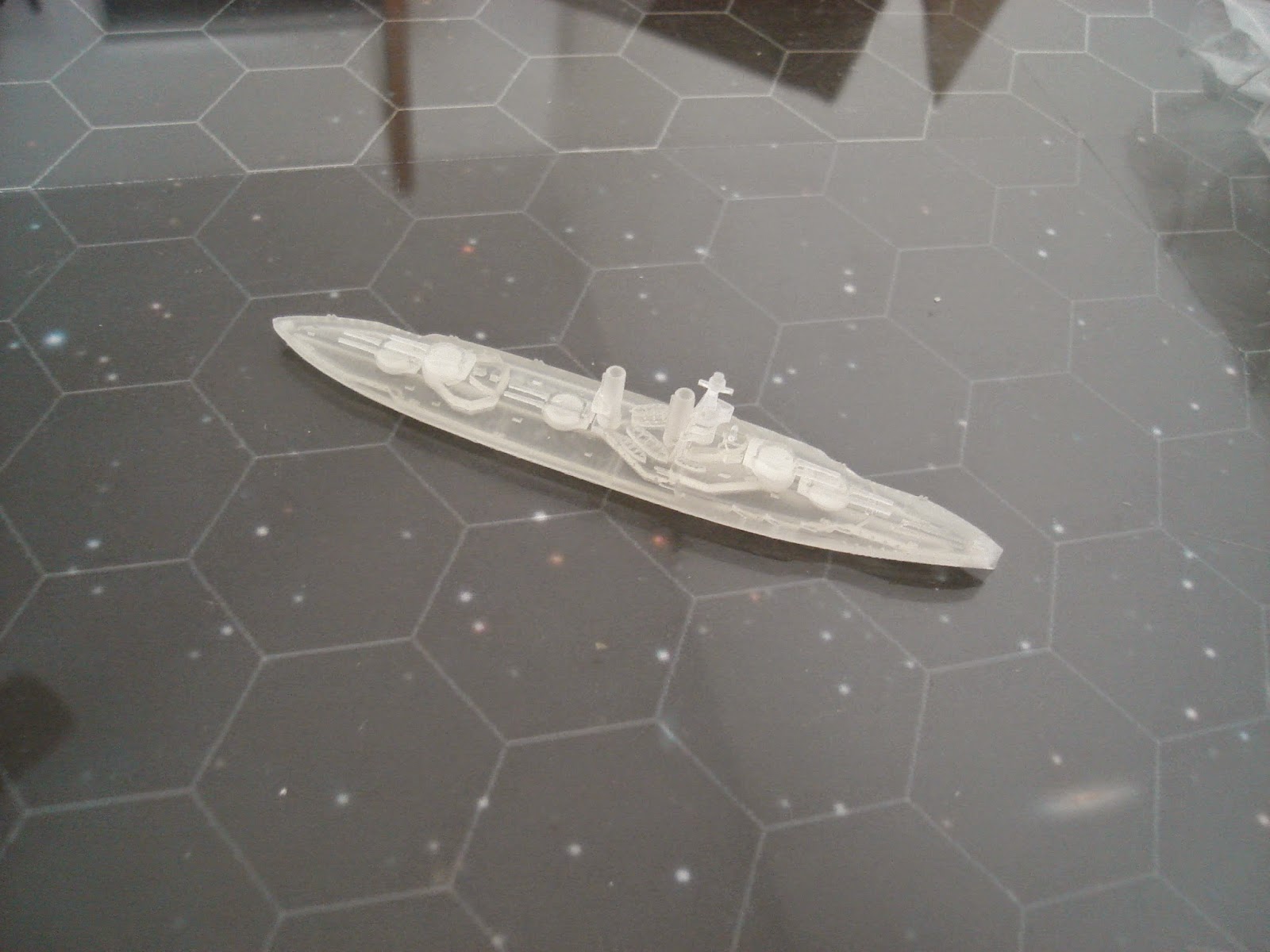
Was down with the flu in September when the box arrived.  Managed to take pics of the new War Times Journal British fleet but unable to write the post.  Hopefully, the seven weeks delay is worth the wait.  

As always the ships came well packed in little bag pouches layered with large bubble wrap.  No breakage here!

Good packing and a detailed, correct shipping invoice - great service from Jim once again!

Fleet in all its glory: 9 BBs [4 Iron Duke top right, 5 Queen Elizabeth bottom right], 3 BCs [2 Lion left, 1 Queen Mary at far left], 5 CLs [2 Chatham, 2 Birmingham, 1 Lowestoft], 16 DDs [8 Laurel and 8 Laforey] and 2 ML [center left].

The BCs: 2 Lion, 1 Queen Elizabeth - can you tell the QE?
http://en.wikipedia.org/wiki/Lion-class_battlecruiser
http://en.wikipedia.org/wiki/HMS_Queen_Mary


Iron Duke with ten 13.5" guns - thanks, I'll take four please!
http://en.wikipedia.org/wiki/Iron_Duke-class_battleship

Queen Elizabeth - 8 x 15" guns and fast as a BC - 5 Please!
http://en.wikipedia.org/wiki/Queen_Elizabeth-class_battleship

Town class CL Birmingham - paired 6" guns on foredeck.
http://en.wikipedia.org/wiki/HMS_Birmingham_(1913)

Town class CL Lowestoft - Sister ship of Birmingham with later tripod mast, 9 x 6" guns also, with pair on foredeck.
http://en.wikipedia.org/wiki/HMS_Lowestoft_(1913)

Town class CL Chatham, 1916, 8 x 6" guns
http://en.wikipedia.org/wiki/HMS_Chatham_(1911)

Now, the Torpedo Boat Destroyers - aka "Destroyers" or DDs, are all L-class.  They made up the 9th Destroyer Flotilla which operated with Harwich Force and were quite active, including 17 L-class DDs on the rolls during Jutland:
http://en.wikipedia.org/wiki/Harwich_Force

I couldn't find out how many had 2 or 3 funnels, so I guessed at eight of each type, which matched the ship logs for Fleet Action Imminent.  Of course, no one will be able to tell on the table but further research at Wiki says that there were four built by Yarrow, which would be the 2-funnel Laurel type.  I probably should've just asked Jim at WTJ, really.  

Most of the small ships will fight on multi-based groups anyway.  Historically, they didn't operate and maneuver independently, especially in a big ship action like Jutland.  with 3 x 4" guns their only real danger to bigger ships is their four torpedoes.  The Combat Resolution Charts for FAI indicate that 12 is enough to hit something if they survive the fire coming in on the run.  Should make for some exciting moments in games!

Laurel - Laforey class torpdeo boat destroyer, two funnels.
http://en.wikipedia.org/wiki/Laforey-class_destroyer_(1913)

Laforey class torpedo boat destroyer, three funnels.
http://en.wikipedia.org/wiki/Laforey-class_destroyer_(1913)

Laforey Class torpedo boat destroyer Legion as 1917 conversion into minelayer.  Note excellent details of mine racks on stern!

Well, this is a fine little fleet.  A bit short on BC, was awaiting Tiger and some Indefatigable class ships but Tiger is now out!  No pic at WTJ unfortunately.  I'll see her in the flesh soon enough after next order, however, which will include a few more German ships that are just out like the BC Seydlitz.  Very happy with all the ships.  The Germans have 9 BBs and 3 BCs, the Brits 9 BBs and 3 BCs, plus a light flotilla of 5 CL and 16 DDs.  The Germans just got three DDs sculpted at WTJ so will have to grab a bunch of them.

Now just have to figure out how to paint them...

Wednesday, September 17, 2014

British Fleet About to Make Port!

Oh yes...the true delight of a very light box from WTJ - War Times Journal.  It's "wargamasmic!"

It's late and I've a nasty flu, so opening the box now wouldn't be nearly as fun.  Sometimes the anticipation is worth the wait, and I know it will be tomorrow.  I've ordered 12 capital ships, twenty small DDs/TBs, and five light cruisers.  The pics on line were stupendous.  Best of all, now that I've both sides, I can start pushing forward knowing that I have all I need to start planning and throwing games.  Always helps my motivation to know there's nothing beyond my control that will derail a future game project.

Wednesday, August 27, 2014

British Fleet Requisitions Commence!

With Jim over at War Times Journal [http://www.wtj.com/store/] announcing their new releases, I interrupted my morning at the beach house to get mine figured out and in - Jim said mine was the first order!  The new releases are:
New Release August 24: World War One - Queen Elizabeth, Iron Duke, Lion, Queen Mary, Chatham, Birmingham, Lowestoft, numerous types of "L" and "M" class British destroyers.
Which is quite an output!  For me, adhering to my desire to have one historical ship where there are differences that Jim is printing [sculpting, in the New World Order], I ended up with an order of:


4    Iron Duke 1916                        WTJ-0355146-24    $8.75    $35.00

     1/2400 Scale 8.75
5    Queen Elizabeth 1916                  WTJ-0355151-24    $9.75    $48.75
     1/2400 Scale 9.75
2    Lion 1916                             WTJ-0355158a-24   $11.25    $22.50
      1/2400 Scale 11.25
1    Queen Mary 1916                       WTJ-0355158b-24   $11.25    $11.25
     1/2400 Scale 11.25
2    Birmingham 1916                       WTJ-0355247a-24    $5.25    $10.50
     1/2400 Scale 5.25
2    Chatham 1916                          WTJ-0355246a-24    $5.25    $10.50
     1/2400 Scale 5.25
8    Laforey                               WTJ-0355317a-24    $2.25    $18.00
      1/2400 Scale 2.25
8    Laurel                                WTJ-0355317b-24    $2.25    $18.00
     1/2400 Scale 2.25
2    Legion 1917                           WTJ-0355317c-24    $2.25     $4.50
     1/2400 Scale 2.25
1    Lowestoft 1916                        WTJ-0355247b-24    $5.25     $5.25
     1/2400 Scale 5.25
------------------------------------------------------------------------

Sub Total     $184.25  Shipping: U.S. & Can. - 1st Class      $10.75 Grand Total     $195.00

This brings me 9 BBs, 3 BCs, Destroyer Flotilla #3, and 2nd Light Cruiser Squadron, both DF3 and 2LCS fought at Helgoland Bight, so seemed a good team purchase.  Note that I was too lazy to try and figure out the exact ratio of Laurel's v. Legions on the internet, so ordered 8 of each.  Anyone who complains will be given the opportunity to drop out of a game.  ;)  

I think they'll give my Germans a run for their money, and I can always play to balance the forces.  Or just let chaos ensue and everyone have at it, which I may do for my initial demo games.  As they're coming up in September, I've got a bunch of work to do!

Now, some pics of these great sculpts / prints:
img_moreinfo_0355146_2400_ironduke.jpg

img_moreinfo_0355151_2400_queenalizabeth.jpg
Just have to say that this ship is "wargasmic"!  About it, Jim says, 
"I'm proud of the Queen Elizabeth, I think most people miss the fact that they had a secondary gun temporarily staged on the focsle deck, and that's how they fought at Jutland. It was removed afterward, but there are post-Jutland photos of those (rather exposed) guns with shrapnel holes in the shields!"  Kudos to Jim for bringing forward the tech and research to indulge our fascination for ship details.

img_moreinfo_0355158a_2400_lion.jpg

img_moreinfo_0355247B_2400_lowestoft.jpg

img_moreinfo_0355317b_2400_laurel.jpg

Note that "coming next" are Tiger, Indefatigable, and more DDs and Cruisers, and I definitely need the additional BCs.  As this order wiped out all my funds from the sale of my Ogre items, I'll have to get more aggressive about selling off some more game stuff.  The rest of the 40K looks to be ready to go...

Just can't wait til' these babies dock!