Showing posts with label WWII. Show all posts

Tuesday, February 1, 2022

Quick-Play WWII Naval "One-Hour Wargames"

"I fear we have awakened a sleeping wargamer..."
"...and filled him with a terrible resolve!"
from: [click]

Well, at least a terrible resolve to play a lot more WWII fast-play naval games!

With building excitement for my periodic naval wargames projects, I redid my fast-play WWII naval rules previously posted [CLICK] in the distinct style of One-Hour Wargames. I used the 6-Hits and 3-dice mechanics, which are very similar but give less attritional outcomes [ie you can totally miss] as naval battles in this era are focused more on gunnery than attriting your opponent, and well, you really can miss completely in naval gunnery!

Mr. Winkie is getting to be a young man, so I will have to see if I can convince him to play this out on the table so for now this version has NOT been playtested!  You have been warned... Do submit questions and ideas below, as Fb is well, evil, and a pain to track things on. 

These rules are focused on ship fighting, but give some - reasonable, I believe - nods to subs and airpower, which on most occasions were supporting the ship effort in a surface battle. My main thinking has been the USN v. IJN in mid-war, and perhaps the RN v. the RA in the Mediterranean, circa 1940-1942. You can tweak these to be a bit more specific as you like, and please send me your ideas!

Without further ado:

One-Hour WW2 Naval Warfare
By Alexander A. Moore of RED IN THE MORNING...
 
SCALE
This is not very NT/OHW to define, but the scale is a 6 minute turn, 1”=1,000 yards. This works out to 5 knots of speed is 1” for example, and 2” is a nautical mile [nm].
 
SHIP TYPES
Battleship BB, Cruiser CA, Destroyer DD, Submarine SS.                 
Force Composition is using the regular charts substituting as follows:
Infantry = CA, Archers = 2xDD, Skirmisher = CA or 2xDD as desired. Cavalry = BB.
 
Basing should be about ½“ - 1” wide and long enough to give ½” of space front and back. Put the naval flag, class and name of the ship on the base!
 
TURN SEQUENCE
The Attacker takes the first Player Turn, the Defender then takes a Player Turn. This ends one Game Turn. Each Player Turn is composed of the following Phases:
Movement. Player sequentially moves all his ships.
Fire. Player declares all Fire at a Target, resolves it, then moves on to the next Target, until all his ships have Fired.
Incidents. Opposing Player removes his smoke, then rolls to sink his ships with six or more Hits.
 
MOVEMENT

Ship Type

Movement

Turns

Turn at

Battleship

4”

90°

End of Move

Cruiser

5”

90°

End of Move

Destroyer

6”

90°

Start and/or End of Move

Submarine

4” / *2”

90°

Start and/or End of Move. *Submerged Movement.

Turns. Ships can turn up to 90° at the start and/or end of the move as indicated.
Minimum Move. Ships must move 2” a turn.
 
TERRAIN
The terrain features in the OHW scenarios must be adjusted for nautical warfare as follows:
Woods = Fog/Squall. Half move speed, Range within is 2” @ -1d6 to all Fire.
Town, Hill = Island. No ship movement into area; blocks Line of Sight.
Marsh, Lake = Shallows. Only Small ships may enter, or none at all as seems best.
Rivers = Peninsulas, Reefs and Sandbars [take your pick[ which count as impassible terrain.
Bridge, Ford = Channel thru Peninsulas 2-3” wide; may be passed by all ships.
Roads = Remove from scenario.

FIRING
The arcs of Gun Fire are 45°off the front, rear and right and left sides. Measure between closest points of a base, or the closest smoke stacks. Roll 3d6 scoring Hits as below:

Ship Type

Range

Hit on

Armored

Size

Torpedo

Notes

Battleship

18”

3+

Yes

L

N


Cruiser

12”

4+


M

N


Destroyer

6”

5+


S

Y

Torpedo: 6” Range,

3d6 @ 4+ to Hit.

Submarine

6”

6+


S

Y

Shore Battery

12”

4+

Yes

L

N


Adjudicate Hits
If target is Small or Armored, lose 1d6 for each.
If at half range or less, add 1d6. If Firing out to an additional 6”, lose 1d6.
Gun Fire through Firer’s Front or Rear arc, lose 1d6.
Ship Torpedoes are only fired through the Side Arcs; Submarine torpedoes thru the Front Arc.
Ship Damage and Sinking
Each ship can take 6 hits, after which they are Sinking. Roll a d6 for Sinking ships each Turn:
1-2 ship stays afloat, 3-4 ship catches Fire obscuring like Smoke, 5 quietly sinks, 6 explodes! Attach all ships within 1” with 3d6 @ 5+, become 3”x3” burning oil slick obscuring as Smoke.
 
Suggestions for Scenario Rules
Fortified Islands. If scenario has a Fort, e.g. #15 or 22, the island may have shore batteries, which count as Armored ships with 12” Range, Firing 3d6 @ 4+ to Hit. These are assumed to be scattered around the island, so draw Range and Line of sight from any point. Alternately, base them on two DD bases, and actually deploy them on the island, then draw Range and LoS from them at 180°.
Mainland. If a side can’t go within 6” of the table edge, the mainland is there, shallows, reefs, etc.
Mountainous Terrain. Large island, may have shore batteries or airfield.
Confusion. No Fire on Game Turn 1.
Scouting. Morning mist blocks the player[s] Fire one turn; the sun then burns it off.
Blundering into Contact. Both fleets move in a column [line ahead] until 6” of the center island; each then rolls a d6 to see if they leave it to port [left] or starboard [right] and turns in that direction, keeping the island 3-6” away, until one of their ships sights the enemy – they then move normally.
Wooded Hill. The shore battery is concealed by terrain, and Fire at them loses another -1d6.
Surprise. Red ships may not move Turns 1-3, or fire Turn 1. Get +1d6 Firing at Stationary Ships.
Scenario 23. Eliminate the river, keep the exit point – should play fine.
Red Disorganization. Red Ships may not move Turns 1-3 so are Stationary. They Fire normally.
Elite Defenders. The Shore Battery hits on a 3+.
Redoubt. This is a Shore Battery that replaces one CA and counts as Armored due to concealment. If invaded, a Landing Force is delayed a turn dicing an attack while the obstacles are negotiated.
 
 
Optional Rules
Submarines
Only the Defender may have a Submarine, which is exchanged for a CA.
Arc of Fire. Submarine torpedoes fire out of the Front Arc; its Gun fires into any arc.
Start. Submarines must start the game on the board and Submerged. They set up with 2 dummy markers anywhere in the setup area that may move like a Submerged SS. A dummy marker is removed when Hit by Gun Fire, or a DD comes within 2”, or if the SS Fires Torpedoes or surfaces. 
Submerged. Submarines may Surface or Submerge at the start of their Movement Phase. When Surfaced, they are like a slow DD per above rules. When Submerged, they have a 2” Move with no minimum, count as a Target in Fog/Squall, and can’t Gun Fire.
Deep Dive. A submarine may Deep Dive at the start of its Movement Phase. This removes it from play. It does not count as destroyed but as having left the play area.
 
Aircover. If one force has BBs and the other has fewer, Aircover is available to the force with fewer and attacks on Turn 1, or the first turn an opposing BB is on the table. Airpower attacks 1-3 Targets [1/2 d6 round up] and each target gets one air attack. The value of the attack is:
3d6 @ 3+ to Hit if one force has one BB and the other none;
3d6 @ 4+ to Hit if one force has two BB and the other one.
Air attacks get +1 d6 if attacking a Large ship or Island.
Battleships attract significant opposing resources as impressive targets!
 
National Characteristics for Torpedoes
IJN Type 93 “Long Lance”: 12” Range, 3d6 @ 3+ to Hit. Cruisers may have torpedoes!
USA Mark 14 Torpedo: 6” Range, 3d6 @ 5+ to Hit
If using this rule, it is advised that the USN force get Aircover.
 
Torpedo Hits result in the loss of 1d6” of of movement each – halve for Armored ships. Once all movement is lost, the ship is Stationary. If using this rule, switch all Torpedoes to 2d6 instead of 3d6.
 
Island defense. In scenarios with a town that has no Fort, the defender may exchange one CA to give the Island a Shore Battery as above.
Airfield. For the cost of a second CA, an atoll / island may have an airfield. This is an unarmored ship that may attack one ship every other turn [8 total attacks] with a sortie of planes worth 3d6 @ 4+ to Hit and with unlimited Range. If an Island has an Airfield, it must first have Shore Batteries.
 
Two Targets. Most BB and CA in this period had two Fire Direction Centers and could handle two Targets. Accordingly, 1 dice may be fired at one Target, and two dice at another target. Each Fire is then modified according to the circumstances.
 
Target Acquisition. Ships generally picked a target and stuck with it until it was out of the fight. This is because acquiring a new target was difficult and took time and skill.  One way to handle it is to penalize a ship -1d6 if it has started firing upon a Target this Turn. Another way to handle it is to give +1d6 for “Fired upon the same target as last turn”. If the Target moves out of Line of Sight, the acquisition is lost and the penalty is applied again. I prefer the -1d6!
 
Smoke. Many ships could lay smoke as an obscurant to enemy Fire. Smoke is a linear terrain feature along the path the laying ship took this turn. If a Target is completely on the other side [ship model or entire base, as you prefer] of the smoke, all Fire at it is -1d6. A black pipe cleaner is perfect smoke!
 
Variable obscurants. Fog, Squalls and even chemical smoke laid by ships can be quite variable, largely depending on the effect of wind. It is therefore more realistic to have a ship decide on a Target that is obscured by these and roll 1d6 for the number of inches to the Target that it can see. If it fails to roll enough inches, the Target can’t be fired upon. Alternately, subtract another 1d6 from its Fire – it’s your scenario!
 
Minefields. Some setups may need an obstruction that attacks, e.g. Scenario #6 Zone 1. For the cost of a CA, the setup area has a minefield that attacks any ship moving through it once a movement phase at 3d6 @ 3+ to hit.
 
Hit the Beach! Some scenarios seem to demand that a Town/Hill be seized, not their batteries merely silenced – consequently, the Island must be invaded!  If both players agree, the defense gets a Shore Battery, and the Attacker may substitute Transports for 1-2 Destroyers [or 2 for a Cruiser]. The Transports may attack the island with a landing force which has a range of 2” and attacks at 3d6 @ 4+ to Hit. If the Shore Battery is based, then the landing Force advances up to 1” a Turn and attacks on contact, per the Melee rules! Neither side may shoot into a melee.
 
Night. The IJN made huge efforts to prepare for it, and even early radar didn’t improve USN performance much. The best one can say is it enabled a sort of parity for a while, until the USN improved both the tech and the technique of radar fighting. Easiest is to limit ranges to 6” or three nautical miles on a moonlit night, using one marker per ship until they are at that range. You could shorten it to 3” even for a new moon. Expect the fight to be short and violent!  For variable visibility, roll a d6 and add it to the Range you set each time a ship Fires at a Target – if it falls short the target is out of Line of Sight. Ships that fire always replace their marker. For flares, Fire them at the start of the Fire Phase, make visibility 6” or 3” around the flare depending on the moon. Ships that do not Fire and are not illuminated or within Line of Sight may become markers again – markers cannot be Fired upon.
 
Traditional OHW Fire Dice. You can return the Fire mechanics to the OHW by giving the ships firing at 3+ the d6+2, the 4+ the d6, and the 5+ the d6-2, and all ships get 15 Hits. But why??  😊

Saturday, April 22, 2017

Brian DeWitt Naval Rules

"Czarist navy crosses globe, docks at sea bottom - news at 11!"


I did manage to reach Brian DeWitt, in a roundabout way through North Virginia Gamers, aka NOVAG where he's a Board Member. Through polite correspondence, we had the following interview, somewhat edited for clarity.

*********************************
Glad to hear you enjoyed the Pre-Dreadnought rules. There's no website for them.  I started selling them only by word of mouth because I had a lot of people asking for them.

Almost all the ship data is based on
Seakrieg 4th ship data (simplified however). The ship images are mostly from Janes Ships or Ship Blueprints webpage.


I sell the latest version of the rules and scenarios on a CD for $5.  I bring them to the HMGS conventions. There are 5 different sets:
A sailing ship set "Form on the Admirals Wake", Spanish American, Russo-Japanese, WWI and WWII. 

I can email the files if you do not attend the conventions and accept Paypal at my juno.com email address: 
brian.dewitt AT [etc] 

I make a lot of different games.  I emphasize playability as the most important factor but try and capture as much historical accuracy I can while maintaining the extremely high playability.  This is accomplished by using creative game mechanics and simple rules.

I enjoyed the article by Neil Thomas on "Simplicity in Practice" you sent me.

****************************
My club has enjoyed the Russo-Japanese set, called "When Dreadnoughts Ruled the Seas" which we play in 1/3000 on a 6x12' table. That being said, the actual engagement space was only about 6x4', so I think one can easily play out the approach moves - and play them faster - on paper. 

Altho the host said that they are more for fun and a "beer'n pretzel" set, I wouldn't say that is exactly true. I just think that he presents and plays them that way. Adding in weather and a few more decision points, and perhaps a bit of morale, and they'd gain significant depth.

So I can heartily recommend the pre-dreadnought set, at the very least, which I've now played 3 times in a large Russo-Japanese fleet context, and found it worked just fine. Most of the added complexity that would make it richer can just be scenario rules from an historical battle, anyway.

For further information, contact Brian!

Friday, April 14, 2017

Three Modern Naval Rule Sets: impressions and overviews

Why does this reality...


Play like this on the table?

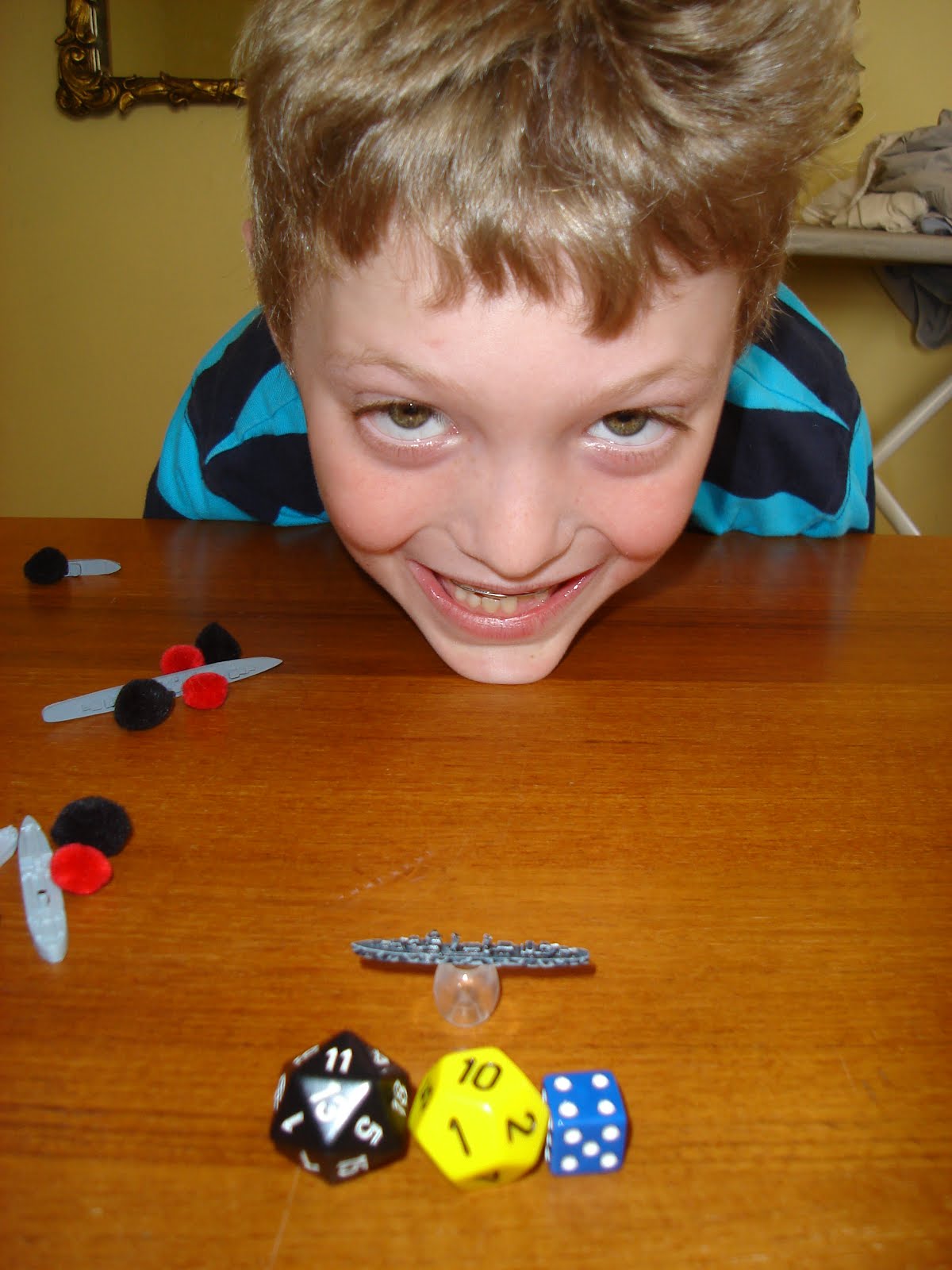
I mean, my son is adorable and he won, and had fun, but...


I've three commercial sets of rules, all of which seem to have merit, and over which I've been thinking as to how to proceed with gaming some of my interests in the near future.

1. Naval Thunder: Clash of Dreadnoughts [WWI] & Battleship Row [WWII]

both are from Steel Dreadnought Games

2. Great War at SeaAvalanche Press WWI
Second World War at SeaAvalanche Press WWII

3. General Quarters 3 [WWII] & Fleet Action Imminent [WWI]
both are from Old Dominion Game Works Naval

Some first thoughts, for those of you new to modern Naval Gaming:
  1. Naval Warfare is highly technological - think WWII but ONLY tanks!
  2. This means that "historical" in context means totally respecting the differences in ships and gear that MAKE the tactics, or at least force them.
  3. It's really time-consuming and a labor of love to plow through all the details and math...let someone else with lots of time do it for you!
  4. Naval warfare is no more "line them up and blow stuff up" than any other type of wargaming is, or at least should be. However, it does have unique characteristics.
  5. Interestingly, Space Warfare is basically naval wargaming. Some more or less realistic than others. However, since it is a "notional" [military term] or "speculative" [literary term] world / universe, it is extremely important that the sci-fi universe closely copy the friction of technology prevalent in real naval wargaming, or it's just dull!
  6. ALL naval wargaming [and space warfare] is inherently strategic in nature, but not all land wargaming is.
  7. There is terrain in naval gaming but not all of it is land! There's also minefields, submarines and motor torpedo boats [all of which function to deprive admirals of movement, just like generals], but most especially there is weather!
So my warning is...don't think you can throw together a set of good naval wargame rules by yourself. It's a genre that really needs you to spend time in it. So commercial rules are - for most of us - far more essential than any land warfare period. The only related genre I think would be airplane combat, again, almost entirely dependent on technological differences to provide friction that makes for an interesting game, and what I don't know about flying and weather...well, it could sink a battleship!

So if you line up your armies of whatever period on a nearly empty table, slaughter away and then say it is dull, repetitive or lacks tactical finesse, that's the same thing as putting the fleets on the table without land, weather or other menaces to big ships, and then saying it is nothing but a dull exercise in gunnery - it may well be, but whose fault is it, anyway??

All this to say that if you love tanks, and wish the infantry would just go away, you will probably love naval gaming!

Impressions and overview of the rules.

The Naval Thunder series has certainly made quite the impression. Many say that it has put the fun back into naval gaming. It is cleanly written, with traditional mechanisms and easily "felt" mechanics that run along the "shoot, hit, penetrate armor, do damage, hope for critical" that many gamers love about naval warfare. It keeps all the additional stuff in the optional rules, from smoke to crew quality. The rules are easy to understand and altho the style is conversational it's not very distracting. That said, I personally prefer when the rule itself, that I actually need to play, is separated by bullet points or italics or something, and is easily found apart from the conversation and explanation.

Our first foray into it was a reply of the battle of Komandorsky Islands. It was pretty quick to pick up, but our use of the special rule for smoke exposed that some of the straightforwardness and simplicity that leaves the rules accessible and likable is at the expense of nuance and friction that can make some scenarios unplayable. In our battle, I quickly realized that I could use my destroyers to lay smoke and by turning at the end of the move hard back behind their own smoke, prevent even my own destroyers laying the smoke from being fired upon. While I'm sure that could have been done, it was awful easy to figure out and do, and rendered the IJN completely impotent, which it wasn't in the real battle. We needed a good hard wind, and some mechanism to prevent my ships from doing - exactly - what I wanted them to do.

While I think that it can certainly be dealt with using the odd special or scenario rule, and also that these rules are easy to tweak due to their simplicity, I have a problem with a basic mechanism being a "trump card" in any player's pocket.

All the rules in the series have excellent listings of ships and other info needed to play the game, as well as point values to help balance scenarios. I give these rules a solid "B" for their ability to make anyone a fan of naval gaming.

The Avalanche Press series has been a huge presence for many many years in the boardgaming industry. The series is huge, with 30-40 games and supplements in the two naval lines, not all of which are in print but most of which are available in the after market industry. All the core games come in boxes with lovely maps showing a strategic theater of operations and a tactical map upon which to fight out actions in more detail. They also come with basic and advanced tactical ship fighting rules, and thorough advanced rules from minelaying to airships to flotillas to submarines...you name it!

Game play resolved - very realistically - with fleets being given missions for which they then plot out their movement. Sometimes they have to plot out their entire foray at sea including the return to port! This strategic mission gives players a larger context in which to put their tactical fighting, and REALLY enhances the experience. The fleets then act out their movements, and when they get close enough have a chance to encounter one another and switch to the tactical map to blast away.

I have to admit I have not yet tried out these rules, nor followed through on plans to adapt them to tabletop miniature gaming. However, I am _slavering_ to do so! At the moment, I've 1898 [a pre-dreadnought game about the Spanish-American naval war], a few of the Jutland series games [WWI] and one WWII game, "Strike South". All look very manageable and are virtually an education in naval wargaming at all levels.

I have a lot of confidence in these rules due to their longevity, the thousands and thousands of copies sold, the clarity of the writing, the presentation of both the big strategic picture and a manageable presentation of the tactical fighting, and the breadth of situational rules that enhance the gaming experience. All the ships have detailed logs, as well as lovely top-down-view counters of the ships [altho they all show the ships to be the same length on the counter, from BB to CL, sort of a Wizards of the Coast scale problem]. The typical boxed game has hundreds of ships and their info handy on the counter and on sheets. 

[EDIT: this means you can wait on getting and painting up ship miniatures; the counters will not only do just fine but have all the info you need most printed right on them - they are 1"x1/2" for capital ships, and 1/2"x1/2" for small ships, however, this has to be balanced against the cost of these lovely games, which can go from $50-100 for a box, and $20-50 for book or bag presentation].

I'm giving these a solid "A-" for the full presentation of naval warfare in a manageable fashion, if without the tactical nuance that some players love. Most of the -minus- has to do with the cost - you can easily get several of the more playable naval games for $10-15, and if you go 1/4800 or 1/6000 escape for under $50 depending on the size of your fleets. OTOH, miniature naval rules usually don't have the tremendous breadth of a game like "Jutland" which has like 60 scenarios, every capital ship represented, and covers the English Channel to the Baltic.

Finally, near and dear to my heart, and played many, many times, is the "General Quarters 3" WWII game, and its companion "Fleet Action Imminent". Not for the faint of heart, yet not overwhelming in detail, this game really is an education in tactical naval fighting. You will learn all you gear, and you will learn it well, or you cannot hope to win a naval action in this game except through the errors of your opponents and the random favor of the dice. This was the game my pal offered after our speedbump with Naval Thunder: Battleship Row. I thought he was nuts! However, he really really really wanted to try it, so I gave it a real effort, and read the rules. Eventually, I found myself sucked in, sort of like reading a well-written astronomical treatise...you think it won't be interesting, or that it will be overwhelming, but eventually you find yourself devoting more and more time on it, and it is actually worth the time!

I was hooked, altho, interestingly, my pal moved on. I then read the rules a few more times, GM'd more games, read a lot of memoirs and decided that Guadalcanal was the perfect, ferocious naval encounter of the modern era. Rarely have so many expensive ships been so harshly used by so many admirals in such a short period of time! It's sort of like fighting about 7-8 battles of the Nile with a few Trafalgars thrown in. It's genuinely horrifying to watch destroyers clash with cruisers and battleships at point blank range, and to realize that you are now so close that you cannot evade a mildly competent torpedo attack.

I eventually settled on running 1/700 destroyer encounters I entitled "DDD - Deadly Destroyer Destruction" or something. I gave each player one ship, organized their squadrons historically, and gave each team three options for the approach, at night, into the "sea of battle". This meant there were nine possibilities in a scenario, so I could re-use them any time. Gamers loved it, and this has been my most-requested game to host.

The downside is that I never really convinced anyone else to read the rules. This meant I slowly became hoarse as we played a 4-5 hour game and I explained the detailed rule QRS and even the cheat sheets I made to speed things along. Even the ship diagrams and gunnery chart required some effort to understand. Once you got onto them, you realized how well they were thought out and play went pretty smoothly. Occasional oopsies on the GMs part were taken with good [enough] grace and we got through with quite a lot of fun.

Overall, these are the best set of manageable rules for tactical naval fights. I think they are a bit much for more than 1-2 ships a player, and even then I "slaved" the second ship behind the other one so that it was a mindless drone, giving the player the chance to keep playing even if one ship was lost.

We fought Savo Island, Cape Esperance, 2-3 Solomon Seas, and Kolombangara multiple times. Having invested many hours [and dollars] preparing the charts and QRS packets in color, I found it made a lot of sense to repeat most of the battles several times, perhaps with a little twist here and there, all based upon historical options. For some more details:
Savo Island AAR
Remember the 13th November!
Neither of which has pics of the actual ships on table, altho there are maps and other tools I use to throw the game. My excuse is that I still had a flip-fone, and kept forgetting to bring my digital camera with me. Mea culpa! My blogging has gotten a lot more colorful, but naval gamers aren't quite as interested in flashy looks as long as the charts are detailed, so maybe it's ok anyway.

There are a few campaign supplements for GQ3 / FAI. "Sudden Storm" is a speculative naval campaign for a 1937 naval confrontation between the US and Japan. Ergo it is more Battle line o' Battleships oriented. "The Solomon's Campaign" is a campaign for actions around Guadalcanal, using a decision-tree approach with minimal book keeping that brings battles into Ironbottom Sound, with the land and carrier actions abstracted. "North Sea Campaign" is the famous naval situation between Germany and Britain in the North Sea during WWI. It uses a strategic decision model, the same decision-tree approach and a mapless search method. Both the latter are by the same author, Nathan Forney, so I assume they are quite similar.

I give these rules an "A+" for tactical fighting, and a "B" for overall picture of naval warfare simply because there are too many trees for players to see the woods, and, at least in my group, not enough continuous play and players willing to read and digest the rules to fully realize their potential and try out the many interesting advanced rules like air, sub, mines, and more. Thus far, it's been too much! But I'll definitely be running some games of this again, carefully limiting the presentation of a new aspect, like minelaying or air/sub attacks. I think these work well at the 1 player 1 ship level, and the 1/700 ships are a pleasure to look at, as well as do the modeling for. Tamiya especially has a number of options, and I encourage players to look into the modeling forums to buy them used from modelers who've given up on building the kit - sometimes you can by kits for 10% of retail if you buy in bulk.

I hope this evaluation of the rules is useful, and leads you to look into them more.

As for me, I think I am needed something that plays fast and easy, yet has a lot of the big picture readily available. For the moment, that means I'm going to be trying out Avalanche Press as a boardgame, with thoughts on how to put it on the table along the way. For WWI especially, I am eager to have big clashes between 12-20 capital ships a side, and each player controlling a squadron of about 4 ships. This means that it has to be relatively easy to fight at a tactical level so that enhanced aspects like command, formations, terrain and such are all able to be easily delved into.

This means that, much like the Starfire II games I've played and shown here, you'll be seeing some boardgame batreps. However, I'll still work on presenting the games to my son, so the One-Hour Wargames: Modern Naval will continue its merry development!

I still may run a 1 player 1 ship game or two of WWI or WWII using GQ3, it just depends on how time and audience works out. Rest assured, this time you'll have plenty of pics as I do have a smartfone now!

I plan to follow up with some demos and AARs with the rules as I experiment a bit with them.

Thursday, April 13, 2017

Naval Gaming w' Admiral Winkie

Somewhere in the S. Pacific, 
the fighting's been real terrific!
...and the music's great, too!

An opportunity that more resilient models - often plastics but some metal figs and ships also - provide is to permit us to play with children who are still working on their fine motor skills. It often seems that they practice them by dropping small, valuable objects and then picking them up, only to drop them again! This is not to be confused by ham-handed, sausage-fingered gamers who squash things because they've too much mass in their extremities. That often sounds like this, "oh wow look at that...oops, sorry" as flag / mast / sword breaks off...*Sigh*. 


In any event, when my 7yo son found the resin 1/2400 Panzerschiffe WWII ships I was sorting, he immediately asked if he could play with them. I thought - why not? The painted ones have been through the miracle dip, and are very resilient. The unpainted ones are either primed in shades of gray or still in the raw resin color. Unless he physically smashed them against each other and breaks a smokestack, they probably can't be damaged. So we had a quick talk about respecting the models, and I took them downstairs to the formal dining table we only occasionally use. It's about 3'x4.5', and plenty smooth.

As I considered what to do, I decided this was a great opportunity to start developing a "One-Hour Wargames" naval game. I'd never tried one this simple - the rules had to be easily perceived to someone who knows nothing about naval gaming, yet at least generally respect realities of naval warfare. I also wanted to begin teaching ADM Winkie basic naval tactics and give him an opportunity to use some math - at school he's just going into multiplication and division. All that being said, here's what I came up with in the ten minutes I took to bring everything downstairs:

  1. Ships. There are three types: BB=Big, CA=Medium, DD=Small.
  2. Speeds. Big, Medium and support ships=3"a turn, Small 6"a turn.
  3. Turns. Up to 90, rotating on the center.
  4. Gun dice. Each uses relatively sized dice: Big [d20], Medium [d10] and Small [d6].
  5. Hits. Guns hit at 50%, or 11+, 6+ and 4+ respectively, inflict one damage point.
  6. Fire Arcs. All ships shoot with 2 dice, one Fore and one Aft, both to Port / Starboard side. Arcs are roughly 45 degrees off the four sides.
  7. Range. Big guns shoot out to 36" at -2 [so 13+], Big and Medium out to 24" at -1 [so 12+ or 7+], Big, Medium and Small guns shoot at 12" with no modifiers.
  8. Torpedoes. Only DD carry, range is 6", hit on 4+, damage is two Points.
  9. Damage. A warship can take two points of damage, a support ship one point. At two points they sink. At one point, they're marked with a red "Fire" marker; at the beginning of the turn, they can "put out the Fire" by rolling 50%. So it pays to keep at a ship until it takes its two Damage and sinks.
  10. Turn Order. Damage Control [both], Move - US then IJN, Simultaneous Gunnery.

The Fleets assembled. One BB, four CA, 3 or 4 DD a side, with their dice next to them.


Below, Japanese fleet. Kongo BB, four CA, three DD.

Below US fleet: BB Washington, four CA, four DD.


Admiral Winkie, the first CinCPACFLT with a retainer, showing his positive attitude. 


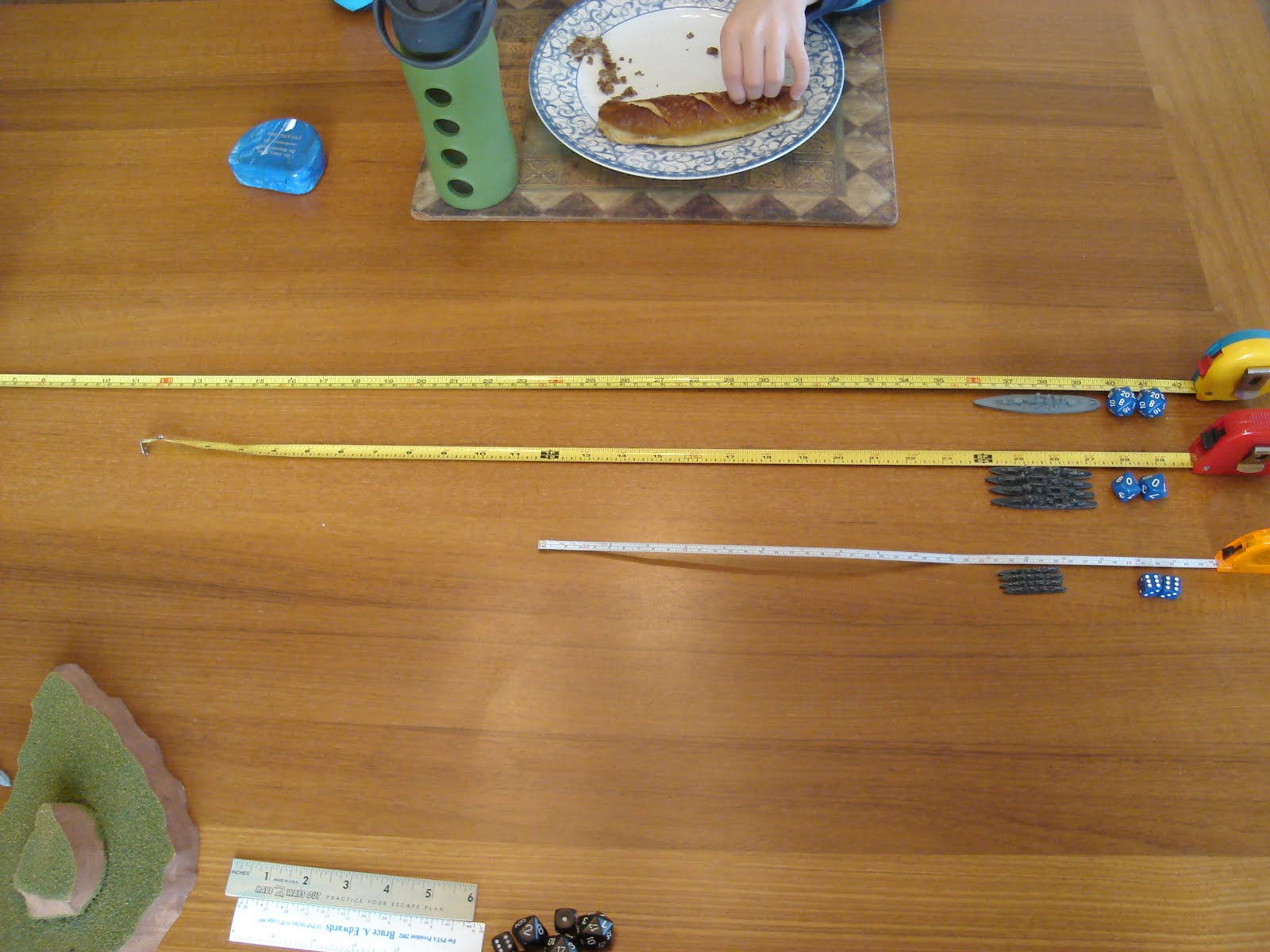
Gun ranges: 36" for BB, 24" for CA, 12" for DD. ADM Winkie has lunch.


Table & Mission. Japanese have fleet oiler, cargo ship and transport at harbor. US will enter top left and attempt to destroy more IJN ships than loses. The IJN wants to cross the table with support ships [towards the outlet] and use its screen and reinforcements to hold off the USN and / or inflict more damage than received.


Close-up of IJN anchorage. Panzerschiffe IJN Fleet Oiler [top], US LST [middle] and IJN Maru transport / cargo ship at bottom. On left, three DD and two CA also at anchor, but planning to weigh anchor turn 1 with support ships. At far left, entering at the table corner as shown on turn 5, the BB and two CA [delayed entry as part of LtWW plan].


US fleet set-up and Turn 1. I just had them set up at table edge, preceded by the DDs. ADM Winkie is moving his big ships up 3" each. The DDs darted ahead a full 6".


Turns 2-4. IJN fleet exits harbor and advances on USN. This does slow the USN a bit as they turn the DD and BB to starboard to unmask their full broadsides. This still has them angling towards the IJN support ships exit point, however and the transports [far left] are slow. The CA are heading straight on, however, to close the gap. The DD accordingly suffer plenty of casualties, with all IJN and half the USN DD sunk, one USN DD on Fire. The IJN have also lost a CA to the BB's 36" gunnery. So far, typical naval game results except that it's only taken about 10-15 minutes and we're having fun - especially ADM Winkie!


ADM Winkie, confident of victory, gives the "V" sign.


Turn 5. IJN reinforcements enter, IJN CA steaming past sinking CA. Note top USN DD with red Fire marker - this is the ship of the game! The closer USN DD with Fire has sunk after taking more hits from the surviving IJN CA. Support ships plod along.


Turn 6. US CA sinks nearer IJN CA. US BB sinks IJN support ship. USN DD still has fire going, but IJN BB totally missed, the shells landing in another lattitude [the dice didn't even add up to 13]. The white puff just shows a near-miss. This made ADM Winkie feel better.


Turn 7. Fleets continue to close. USN BB sinks another support ship. Off-camera at top is the last USN DD, on fire, still closing at full speed.


Turn 8. ADM Winkie puts out the Fire on his last DD [rolls a 4, pictured at top]. IJN gunnery at said DD continues to be pathetic - perhaps the burning oil is obscuring splashes? Third support ship steams on. IJN do manage to sink one USN CA and Damage another.


Turn 8. Fearless USN DD takes on two CA and a BB! It misses with guns and torpedoes, causing ADM Winkie to get pretty upset [a conversation about the random nature of dice is in order - I think he feels he just didn't roll it "right", a topic for older gamers, also]. 


Turn 9. US DD continues to close, torpedoes IJN CA sinking it. USN gunnery sinks CA but the maru transport steams on against the blocking DD. IJN gunnery is all misses. 


Turn 10. USN DD turns about, torpedoes IJN BB and sinks it! USN gunnery sinks maru transport. IJN gunnery continues its streak of misses.


Final results! IJN lose all 11 ships, USN loses three DD and one CA. Hero of the day is the pictured USN DD, an old Benson sporting Measure 12 modified paint scheme [for '42].


A tear-free ADM Winkie. We had fun and we used some math.


Analysis. I'm pleased that one of the old Benson DDs with its veteran crew was the hero of the hour. The general run of the game typifies most naval games, IMHO, with it being largely a gunnery contest, and the smaller ships being picked off early. This was also caused by the range bands. The ships sometimes had no other targets than the DDs. The CA fire hit especially hard.

The use of different sized dice was mostly due to a desire to have penetration rolls next time out. My general thought is to have Penetration be related to dice / ship size. Here, the only effect was to make CA shooting a 7/12 at 24" while the BBs had a 12/20, a 10% advantage.

This reminds me how important it is to have additional factors present in a game. Certainly Armor / Penetration is very important. The speeds are certainly off - big ships don't move half as fast as DDs! Actual speed ratios for WWII warships are more like:
DDs, CLs, and CAs = 30-35 knots
BBs and CVs = 25-30 knots.
Giving a spread of 25, 30 and 35 knots or ratios of 5 / 6 / 7.

Gunnery ranges are pretty good for the table we used [3'x4.5', with eaves pushing it to 7.5' long if needed]. In my copy of GQ3, Big guns are about 18K yards, medium about 12K, and small about 9K. Big and medium guns can go out to about 24K with marginal hit chances. So ranges should perhaps be more like:
24" = BBs and CAs with 1.3 normal hit chance [about 19-20].
18" = BBs with normal hit chance [CA at about 9-10]
12" = CAs with normal hit chance [DD at about 6]
  9" = DDs with normal hit chance.

This use of scale at 1" = 1,000 yards gives table speeds of 2.5", 3" and 3.5" for the ships. Bit of a crawl, really. However, I believe the gunnery fire is figured in 6 minute blocks of time, while movement is in a 3 minute block of time - at least that is what it is in Fleet Action Imminent. If so, I could double speed distances to 5", 6" and 7", all heading into a total 6 minute turn for both gunnery and movement. A check of the GQ3 rules still has a 3 minute / 6 minute design paradigm, but it's not clear that the 2-1 gunnery / movement ratio is present. I'll have to inquire.

Fire Arcs in GQ3 are almost at 45 anyway - they have them at 40 degrees, giving a 100 degree broadside instead of 90. I'm not sure this is worth changing.

Ship damage. It occurs to me that the hull blocks of GQ3 are in numbers of 6-8 for all ships. This is adjusted by using the equivalent Hits table which multiplies hits by 1, 1.5/2, 3, 4, and 5 depending on the size / armor of the target [in 5 categories] v. the weight of the gun. So a BB big gun that scores one Hit on a DD gets 4-5 Hits, each hit being a roll on the Damage Table. Pretty lethal. This is somewhat ameliorated by the fact that lots of big gun shells just went through the unarmored DDs anyway, not to mention their small size and high speed.

Small Targets -2 for big guns firing at DDs.

Future developments.
One-Hour Wargames is excellent not so much at the simplicity of the rules, but that the 30 scenarios provide tremendous, nuanced play that is carefully derived and set to relate to the measurements of the rules themselves. In other words, 

  • the turn limit, 
  • victory conditions
  • table size
  • terrain type, size and placement
are all closely linked together.

For starters, terrain needs to be approached - some initial thoughts...

Terrain:

  1. Land - blocks Line of Sight and movement.
  2. Fog - blocks Line of Sight.
  3. Smoke and Mist - obscure Line of Sight.
  4. Shallows - restricts movement.
  5. Minefields & Submarines - affects movement by attacking ships.
Well, that's my initial foray into a One-Hour Naval game. I hope it encourages you to play with your youth as well as consider what you can do for an hour in your spare time instead of watch the 'tube, You or TV, or otherwise!