Saturday, April 18, 2020

Starfire: Reworked Tech Level Timeline & Ship Building

   Turning Starfire Upside-Down [a bit]


OK, taking the plunge and going for sharing this draft. A number of goals were set:
- Engine Movement was converted into Thrust / Newton's First Law. Ergo, Thrust is more important and priced higher.
- Ships with large mass are now a bit more ponderous, with low acceleration [Thrust] and turn modes.
- I got rid of most 1/2 space use - it's just a pain.
- The Tech Levels are quite different. They represent a more typical, "weapon development history as we know it" approach that pendulum swings from offense to defense a bit. So Ships have armor, guns and missiles at first. Then the Energy Beam shows up that penetrates armor [distance, evasion and overload dampener are your counter tactics to this]. Then Shields are invented to protect you from Energy Beams. Then the Laser Beam shows up that penetrates Shields, etc etc. You can at least understand why each Gadget is getting invented at the next tech level - some Admiral went into the R&D lab and said, "Dammit! We need something that can do _______ better!"

- I plan to slow down the chronology of tech advance a lot, more like 20-30 years per tech level. This will mean that ship development will advance at a more realistic pace, sort of like from 1850-1950, instead of jamming all 100 years into a 5-year war with the Khanate. Sure, that may be what the future will be like, but...money and resources still talk, and your naval budget has to justify the expenditure!

The Notes show thoughts I want to try out. Some of pretty certain, others are pretty speculative and may go nowhere. But the overarching vision of naval architecture, weapons and tech advancement is pretty set. TLI is a clash between systems as we know them, mostly; it may be compared to modern naval warfare in space [without the fighters yet]. The main tension will be distant missile shooting and Point Defenses v. Close-Range Gunnery, and I'm sure both schools of thought will have their advocates!

I am particularly excited by the advance to TLII! The Energy Beam will be a significant tactical menace, making Armor useless and the answer will be distance, evasion and the Overload Dampener. I think that the Guns and Missiles will still be viable, just less decisive than capital ships with E-beams flying around! I may need to lower the hit chances a bit [due to attenuation] or enhance the ability to maneuver unpredictably to the gunnery computers.

I welcome constructive criticism, just comment or email me at my gmail. That is brasidas19004 at the usual ending.

NOTE: all data is Intellectual Property [IP] of Starfire Design Studio here [CLICK] and no infringement on their rights is intended. All information is for fan use by people who have acquired the Starfire 2nd Edition Rules [and hey, won't be any use if you don't have them, actually!]. These rules are available for a VERY reasonable price [HERE].

Starfire Ship Construction
Hull costs in MegaCredits [] and their Characteristics

Hull Size

Cost

Spaces
Turn
Mode
Max
Thrust
Thrust
Cost
Space /
Thrust
Escort – ES
33
 10
2
8
 5
0.5
Corvette – CV
60
 13
2
6
 6
0.5
Frigate – FG
72
 18
2
6
 7
1.0
Destroyer – DD
130
 25
2
5
 8
1.0
Lt. Cruiser – CL
185
 35
3
5
 9
1.0
Cruiser – CA
300
 50
3
5
10
2.0
Battlecruiser – BC
480
 70
3
5
14
3.0
Battleship – BB
650
100
4
4
14
3.0
Dreadnought – SD
900
135
5
4
16
4.0
Freighter 1 – F1
60
 20
2
4
 4
1.0
Freighter 2 – F2
100
 35
3
3
 4
1.0
Freighter 3 – F3
150
 55
3
2
 3
1.0
Freighter 4 – F4
250
 90
4
1
 2
2.0
Base 1 – B1
100
 20
-
-
-
-
Base 2 – B2
250
 40
-
-
-
-
Base 3 – B3
500
 75
-
-
-
-
Base 4 – B4
750
100
-
-
-
-

Ion Engine units have been renamed Thrust. Adding Newtown’s First Law to ship movement makes relative acceleration the most important movement aspect. Smaller ships may now escape the clutches of larger vessels which are usually slower off the mark but way more heavily armed – but they need to have a quick-witted commander!
Thrust cost has been increased a bit. The ability to outrace a superior ship is almost always a matter of life or death for the weaker ship, so one might say that speed is the single most important factor in positioning, and positioning the most important factor for weapon range friction zones and therefore combat.
The BC has been repriced to be what is was in WWI – a fast, heavily armed, lightly armored, but expensive patrol vessel.


System

Code
Cost

Space
Tech
Level

Special Rules
Armor
A
2
1
I
Max 20% of hull spaces; ignored by E
Cargo Hold
H
1
1
I
Max 10% of hull spaces on warships, but all must have 1+ [SD 2+]
Bulkhead
B
2
1
I
Max of 1B for every group of 4 H
Gun
G
5
3
I
*bang!*
Missile Launcher
M
10
3
I
Fired at +10 Thrust? Volley marker movement?
Ion Engine [Thrust]
I
*
*
I
Cost & Thrust on hull chart, above
Science Instruments
X
10
1
I
Per scenario victory conditions – scanners?
Multiplex Tracking
Mx
*
1
I
M2/30, M3/45, M4/65, +30 M¢ thereafter
Point Defense
D
25
2
I
°
Tech Level I = pre-all Beam technology
Gun/Missile Launcher
GM
20
3
II

Energy Beam
E
35
4
II
Ignores A and H – makes A obsolete?          
Overload Dampener
O
20
1
II
Cancels 1 E hit per volley; may cancel 4, but then burns out
Transverse Thrusters
Tt
*
0
II
10% of hull cost – reduces TM by 1, allows Evasive Action
Tech Level II = Energy Beam breakthru; bypasses A, countered by O, Tt only; results in total redesign of ships with much less A and >ECM
Shields
S
4
0.5?
III
Ignored by Lasers; could take up 0 space – added to all ships
Datalink
Dl
40
1
III
Too cheap? Tech Level II?
Particle Thruster
Pt
*
0
III
Decrease Max Thrust ratings by “1” [min 1]. *Pt is 10% of Hull Cost
Tech Level III = Shield breakthru; results in ship refits to
Laser Beam
L
25
4
IV
Ignores Shields
Tractor Beam
T
10
2
IV
Shorten to 1 Hex & 1pwr/tech level; voluntary tug mainly
TL IV = L breakthru cancels S; S now leveled with A, each needed as have a weapon that ignores.
Shearing Plane
Sp
15
2
V
Cancels T
Force Beam
F
25
4
V

TL V = Sp breakthru cancels T use as major tactic, so probably boarding actions, also. F is logical extension of T and Sp development
Primary Beam
P
50
4
VI
Ignores S, A, H, hits d6th system – can miss. Shoots e/o turn
TL V & VI = P/P2 breakthru makes S and A of dubious value; Defense returns to TLII response to Energy Beams
Primary Beam 2
P2
100?
4
VII
As above, but shoots EVERY turn

Notes on variations and rule changes.
  • Warp Point transit exit velocity should be 1 hex/turn. This represents the momentum supplied by the transit itself, all other ship velocity was lost in the immaterium of the warp. This also makes strikes thru a warp point slower and gives the inhabitants more warning!
  • Unnecessary to differentiate port/starboard guns or shields; ships can rotate in reality, there’s no up or down!
  • BFG Command Rolls: evasive Action [-1 H# penalty for you and your targets,
  • Advanced Maneuvering: better at Evasive Action?


New Ship Stats
These are what the two ships from scenario #1 look like now, using my modified point values and [significantly] altered Tech Level timline.

Alkzar – TL1. ES, (2) A A A A G I I I I I (6)                                                 
[Spaces/4      +0.5+3 +2.5  =10]
[Cost/33+8       +5 +5  +25   =76]
Alkzar has a bit more Thrust than Discovery. While about half the size, she has identical Armor [4] and one weapon squeezed in, a Gun that is best at short range. As a system defense boat and revenue cutter, about all she may need instead would be one less A and two less I for another Gun; that would also be worth trying out.

Discovery – TL1.  FG, (2) A A A A X H H H H M X I I I I  (5)
                      [Spaces=18/4            +1    +4    +1+3+1  +4    =18]
                      [Cost/72      +8         +10    +4   +7+10+10+28=149]
Discovery has solid Armor in case she bumps into something while advancing the frontiers of science [or science fiction]. Her 4 Holds and 2 Scientific Instrument clusters [X] aid in her collection of data. She has one "weapon", a Missile Launcher that is normally used to launch data drones and scientific rockets around a solar system to explore faster. There are a few military grade missiles around, and a few other rockets that a talented science officer could jury rig into something that goes "BOOM!". But why would we need that...?

So we have a classic encounter shaping up. A smaller, faster ship that likes to fight close up, v. a larger ship that fights at a distance, but feels morally obligated not to shoot first! Both have their essential combat power at the end of their system line, 7 systems for moving, fighting, and [for Discovery] the needed instruments to fulfill the victory conditions.

Next up: Scenario #1 "First Contact 03MAR2205" at an unimportant star, VX134!

Wednesday, April 8, 2020

Rule Modifications for Starfire

Mass-ive!  And they should act that way on the table!
Maneuvering ships in Starfire (William H Keith illustration, Nexus 10, Task Force Games, Oct 1984)
https://oldschoolfrp.tumblr.com/post/186521407401/maneuvering-ships-in-starfire-william-h-keith

A good concise intro to Starfire, albeit a tad out of date:

https://www.starfiredesign.com/starfire/introduction/

fun little post at the piazza:
http://www.thepiazza.org.uk/bb/viewtopic.php?f=88&t=23045
Just shows how easy it is to use and adapt these rules.

So, having fun getting back into these rules and definitely have more experience with naval games. This has helped developed some of my thoughts on space ship wargames in general, and what I'm looking for in a game.


1) History v. Fiction. As a big fan of the WWII Solomon Islands campaign, I think that you can in fact have different navies, different ships, different tech and different strategic / tactical issues, and have a great naval wargame. 

I think a lot of sci fi wargames give good tools for gaming, but they get into trouble when it comes to differentiating between [fictitious] cultures and their gear. History delivers the issues right into the game designer's hands. The last big space game I know well enough to comment on was Battlefleet Gothic, but some people insisted that the Eldar fleet was broken - it was probably just not easy to handle...most warhammer and GW gamers wouldn't know tactics if it erupted thru the lining of their stomach wall at breakfast.


2) Newton's Laws. I'm realizing that they matter to me, especially the First Law. They make it space instead of wet navy. Doesn't have to be "Ad Astra" level in detail, just give a good feel for inertia, acceleration / deceleration, thrust, etc. So I said that once you were moving in a specific direction at a specific velocity, you just continued at that speed/velocity until Thrust changed it [accelerate, decelerate, or turn].


There are a few things that I don’t like about the movement system; I appreciate the impulse mechanic being an attempt to allow players to move simultaneously without writing orders, but it is cumbersome. I sometimes forget which impulse I’m on!  You can also screw up your ship movements by forgetting which are moving in which impulse – this is more a product of ship differentiation as if you make them in identical batches a lot of this goes away.
Don’t like that it ignores Newton’s First Law. I have been tinkering with a very simple NFL inertia system and it works well. It also adjudicates power – the Ion Engine Units – to various systems to enhance performance. With the smaller scenarios, this gives the players an opportunity to do things that make sense but also achieve a bit of tactical surprise with EW / ECM affecting the to hit number.

3) Ship design. Dying to do this. Mostly in the area of making for interesting game play between different fleets with different gear. I think tactics revolve around the gear, and the hard part is making viable different fleets with different tactics.

4) Dicing. Switching to d12 with a natural ‘1’ being a critical Hit that damages like a particle beam. This significantly speeds up play as each firing system can be a colored dice, and you can roll for all your shooting at once.


5) Turn Modes. Movement in a previous turn doesn't count for Turns. 


I also really dislike tracking anything - ANYTHING - in any game across two turns, unless it is super easy like flipping a counter over to "disrupted side". So all turn mode movement must be spent each player turn and doesn't carry over. Think of the turn as less about time and more about decision points for captains and admirals, and you'll see it makes sense.

6) Energy Allocation. It has to power Shields, Weapons and acceleration/deceleration and each 60° Turn; any excess may be allocated to EW / ECM [Electronic Warfare / Electronic Counter Measures] to modify your Initiative die roll. So for example: if you have 6 Ion Engines, you might allocate 2 to S/weapons, 1 to a Turn and 3 to ECM [giving +3 to the Initiative roll]. I also tinkered with the ECM package as giving a bonus / penalty to your Hit ability; this time I gave 1:1, so 3 ECM made you harder to hit by 3 on the dice.

So, how did it play out?

I kept the 2d6 rolling and the constant IN to the Khanate ship for this playtest.

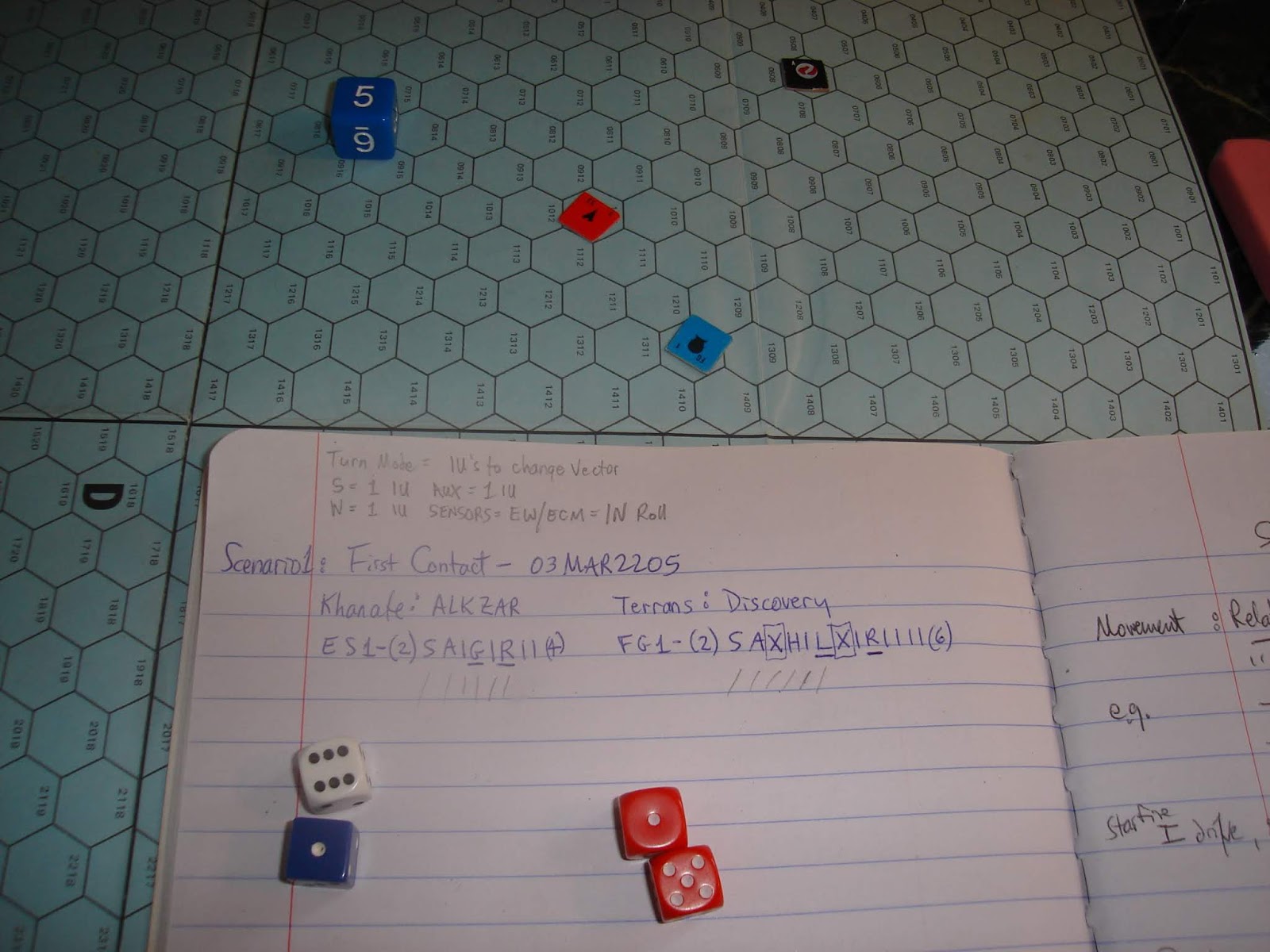
Using my handy 99cent marble notebook, I've made a high tech record sheet, *ahem, seen below. In the first couple of turns, the Terrans research vessel Discovery moved on spending Thrust to close quickly - scientific curiosity, no doubt!  The Alkzar would like to keep distant but also protect the planetary outpost from the intruding vessel, ergo it fires a missile [with 2d6 still, didn't switch to d12 yet] and hits, knocking down Discovery's shield.

Turn 3, both captains pull some maneuvers, and end up on mostly opposed courses and much closer. The Khanate Khats just can't shoot and miss with their Gun. The missile knocks out the Discovery's Armor. In response, the Terrans roll very well - outraged sensibilities? "But we're SCIENTISTS!" - and knock out both Shield and Armor.

Turn 4. The Discovery is moving rapidly along, at about 8 hexes / turn, and darts around Alkzar and scans the planet with its scientific instruments for a tactical win -if it can escape. Alkzar corkscrews clockwise to keep Discovery from getting onto its tail [Khats hate that]. With only one weapon, the Khans get a hit and the Terrans miss. Still, Alkzar has only three systems left, its Gun/Missile Launcher and 2 Engines. They really need to trim a weapon from Discovery to survive much longer.

Turn 5. Some tight turning, then Alkzar has IN and hits, knocking out the Terran Laser. At three hexes, it would've hit for 2 Dam and pretty much toasted Alkzar - whew! The Terrans shoot second and still pull the last tooth off of Alkzar - the Khans really needed a miss there.

Turn 6 [ignore that die!]. The Terrans speed off with a tactical victory. With nothing but one engine left, the Khanate isn't in a position to do anything about it. As it is a first encounter, the Terran scientific vessal decline to vaporize the alien vessel, hoping that a salvageable future is still possible with this species..."After all, Captain, didn't we intrude into their system?  Surely it was a natural, if hasty reaction for most species?"

Well, that was cool!  I liked the continuous movement. You only need to fire up the engines when you want to increase/decrease speed or change direction. The power can then be used for other fun stuff. It definitely felt more like space and didn't require much effort.

Obviously, another play is needed!  This time I added in some more resource allocation and started to write orders each turn and track them.

Turn 4. The usual closing game had the Alkzar better positioned, but their obligation to protect the planet from the intruding vessel doesn't give them many choices. If they could only abandon their charge, perhaps they could snipe with a missile at long range. Still, Discovery has better weapons at long range, anyway, with the Laser way outclassing the Gun in range [almost triple effective range] and damage [double], plus it ignores Shields [not that it matters, there's only one on Alkzar]. With 50% greater engine power, Discovery also outclasses the little system ship in terms of game speed, 6 to 4.

Turn 5. Despite smart maneuvering and good luck, Alkzar is still losing the fight with 3 hits to inflicting 2 on the larger Discovery.

Turn 6. Alkzar gets pummeled for two hits and misses Discovery. Fortunately, the Terrans are not without mercy and begin to depart with an easy Tactical Victory. This could easily become a Strategic Victory as there's nothing the Khanate can do to prevent Discovery outmaneuvering it to get a 2-hex scan with its scientific instruments unless Discovery starts to completely miss every turn with both its weapons. Not likely.

Turn 7. The Terrans head for the Warp Gate. Alkzar rolls a critical hit with the natural '1'! This knocks out an additional system, but the total is one scientific instrument and one Hold.

Turn 8. Terrans are outta there!

I enjoyed the changes. Still, simple is always better so I'll be implementing the ECM changes in a bit of a simpler way, altho I am going to port over the missile method from BFG more or less. They will fly around as a counter chasing targets.

ECM bonus. If you have more ECM, even if you lose IN you get a hit bonus of -1/die roll, and are targeted at penalty of +1/die roll. It is simple and represents that you've out performed / out resourced the opposition on allocation to EW.


Missiles. Switching to a counter that moves, like BFG.

Starfire’s use of missiles also is a bit awkward – you can shoot a missile towards your aft quarter at a ship going away from you at high speed, but it still accelerates fast enough to hit in one turn. This avoids tracking missiles, of course, but I think  Battlefleet Gothic has it right when it handles fighters and ordinance [missiles] as the same thing. What is a fighter but a missile with full decision-making capabilities that can then be retrieved?  


When beam and other speed of light weapons arrive, relative speeds don't matter much, but the acceleration of a missile fired between two ships heading away from each other at speed 6 each at max range would be an acceleration in 30 seconds of around 32 hexes!

Monday, April 6, 2020

Return to Starfire 2nd Edition: Box Rules

I dig the rules, the graphics, EVERYTHING!

From my previous series of posts here [CLICK]

Well, it's been over five years, and I've got the Space Bug again [not to be confused with the WUHAN BUG] which means more Starfire, and some rules experiments. Expect several posts on this, as I've already played a number of games and been re-reading the rules.

Amazingly, Starfire Design Studio has kept this game going in its many variations for over 40 years! Nearly everything is still available from Wargame Vault, here
 [CLICK] and there are even shapeways ships here [CLICK] altho they are a bit too big and too pricey for my purposes. There's some lively discussion at their forum, too [CLICK].

I dig these rules. They can be played as simple or as complex as you want just by using - or not - the various weapons and ship types. The only thing missing for me is movement rules that are a bit more realistic / vector oriented. The rest of the rules seem to hold up quite well. Like many naval games, the issue of rules complexity has a lot to do with ship variety and technical differentiation. There's really nothing to say that in the distant future, starships won't be treated more like Sherman Tanks than WWII naval vessels, and production will be streamlined as well as cut'n paste with the technical widgets. Anyway...

These 2nd Edition rules have a lot going for them, still, and I strongly recommend you invest a measly $8 on getting them. They clean up the original micro game and its successor,
Starfire II [which added carriers and fighters, effectively taking Starfire I from WWI to WWII]. And even the scenarios have been re-balanced. A thoroughly cleaned up edition.

Well, to get back into the game, I first did a replay of Scenario I, this time with the 2nd edition. The victory conditions were tweaked in this edition, and seem a lot more realistic. The Terrans are still entering thru the Warp Point at left, and discovering the Khanate planet and its patrol ship. They need to get within 2 hexes of either with scientific instruments intact for a tactical victory, and both for a decisive victory. The Khanate side wins if he destroys Discovery [not your kindler, gentler aliens!]. It's a draw if the Khanate fires upon the Discovery and it escapes with news of "less than friendly" aliens at this particular Warp Point. The Khanate player has Initiative and the drop on the Discovery - Terrans can't fire for a full turn after being fired upon first.

Turn 1 start. Khanate Escort class ship Alkzar is on routine patrol, towards the mostly likely point of danger, the Warp Point, facing it.

Discovery enters. Alkzar moves 4 - max speed - towards her, hoping to get two solid hits and a superior position before Discovery can respond. Will it work?

Turn 2. Alkzar veers to starboard, fires, but misses with the Gun, hitting with the Missile. Discovery's Shields are down!
 whoop, whoop - red alert, red alert, all hands man your battle stations...

Terran Turn 3. Discovery positions itself for a stern rake [ships cannot shoot into their rear 60 arc]. Terran is always moving first as the Khanate player always has the IN. The Khanate player therefore always moves 2nd and shoots 1st!Discovery achieves a victory condition, getting a readout of the Alkzar with its scientific instruments at 2-hex range.
Turn 3 Khanate. But the Alkzar doesn't let that happen. She swings to starboard and gets a bit of distance as well as a blocking position to prevent Discovery reaching the planet. Both blast away at each other with hits at close range. Discovery is a bigger, faster, ship. Both have the same firepower, two weapons, but Discovery has one Laser which is more dangerous at close range.

Turn 4. Discovery and Alkzar tighten up a bit, both to each other's starboard side, and pound away with weapons. The Discovery's Laser inflicts 2 hits for 3 total. Alkzar loses its Gun, and now has 1/2 the firepower and 1/3 the engine power of Discovery. Doesn't look good...

Turn 5. Alkzar tries to gain a bit of distance while Discovery gets scientific readout of Khanate planet, for decisive win. She then smokes the Alkzar and the debris scatters.

Well, that was easy. The Alkzar may have the drop on Discovery, but the Terran Laser makes a big difference in firepower, and with 6 Engines compared to 4 for the Alkzar, Discovery is just too much for it to handle.

Naval tactical maxim: if you are outclassed in BOTH firepower and speed, you are left with luck or prayers, whichever you favor. A small ship HAS to be able to out maneuver a large one as we will assume it is outgunned.

Probably the most effective small ship in Starfire would be high-speed with plenty of missiles, giving it some long-range punch. It can then maintain distance with its speed.
This is part of the fun of Starfire - you can design your own ships. The question then becomes how you model design philosophy differently for the two sides lest they have identical ships.

Well, that didn't take very long, so I immediately played again, this time with the thought that Alkzar should try to maintain distance, forcing the Discovery to close in, get scientific readings, then clear out to the warp point - with its greater speed, it should be able to do so but we'll see.

Turns 1 & 2, the ships get in range while Alkzar opens up with a missile hit - the Gun is way out of range. Discovery has a missile, also, however.

Turn 3, Alkzar keeps some distance while Discovery closes in. Unfortunately, Alkzar misses with its Gun while Discovery rolls well and hits with both its weapon systems.

Turn 4, Alkzar loses some distance while Terrans scan the Khanate planet. This time they each get only one hit - lost chance for the Khanate ship to catch up! They have both lost 5 systems, but the Alkzar has lost two Engines and has move 2 v. move 5 as well as its Gun. Doesn't look good with half the firepower and half the speed!

Turn 5, the slowly creeping Alkzar has its fangs pulled, and a whisker, also [ouch!]. It is now at the mercy of the Terran, who can close in and take a close reading of the ship, and depart with a decisive win.
 Called the game at this point - decisive Terran win.

Well, Alkzar did better, but clearly needs the Gun replaced by a missile, perhaps two, and she may then survive while pecking away at the terrain. Might also help if they used the planet as an obstacle to hide behind occasionally.

So this is a RAW post. I'm still reading the rules and getting caught up on all the wonderfulness that is Starfire II!

Next post: tinkering with Vector movement!

Saturday, February 15, 2020

Forged in Battle 1:3000 fleets hit the streets! Well..."Hit the waves!"

Alexander Hay-Whitton, a South African based in Bangkok has corresponded re: the Forged in Battle review posted here [CLICK]. We went back and forth a few times and I cajoled some extra commentary and pics from him. This is undoubtedly what the FiB sculptor wants to see, so, enjoy!


"The first outing for the Forged in Battle Trafalgar fleets. I finished them yesterday [he did it in a month...I'm envious!]. They look pretty good, even with my less-than-renaissance brushwork.

The rules in question are 'Rum, Buggery, and the Lash', trying to do a sort of DBA for sailing fleets, since I don't think the usually massed record-keeping ruleset suits local conditions. 

Less than glorious, it was a disaster! The rules actually penalized the fleet with more frigates, and we ended up starting way downwind. There were also numerous opportunities for the sort of gamer who plays the loopholes rather than the game.... I need to do a lot to the rules before we try again!"

lovely overview with an island or peninsula to left


"The cloth representing the ocean is cheap Chinese silk (Thai silk is better, but would be wasted on such a project)."


Very nice building models - must ask what they are!

View from the crow's nest - sails ahoy!


maneuvering for a positional advantage but it seems blocked!

things are looking pretty scrappy here

***********************************

"Since then, we've had another, much more successful go, following a lot of rule revisions."

"Too Geometrical"


"This second time we brought off a Nelson act, coming in from windward and cutting an enemy squadron in half, beating it down with a full squadron's fire, boarding, and capturing five SOL before nightfall." 

"Break the line!"

Wild melees above and below!

"We also landed some 2mm Irregular Miniatures marines and captured the land battery."


"S. Valentine is captured!"

Players were myself (Nelson), my wife Krisanan (Collingwood), and my regular opps Anthony Reardon (Villeneuve), and Englishman, and Mike Seely (Don Miguel da Siljio), a Canadian.

Rough being a wargaming Alexander, isn't it? Gives you a lot to live up to!

******************************

Yes, but Alexander wasn't much of a naval commander, anyway, altho some say he was "at sea" mentally!

Well, that's all for now - Alex's work is inspiring me to get back to these ships and playtest the rules I was favoring, Bob Cordery's Portable Naval Wargame. The rules and many others are a free download here [CLICK].

Thursday, August 1, 2019

Ace of Aces - the miniature game

Hexes!? We don't need no stinkin' hexes!

https://boardgamegeek.com/image/517636/ace-aces-flying-machines

Over with the old club the other night, and had a great chance to get into some WWI flying ace action with the hosts miniatures adaption of his favorite WWI flying game, "Ace of Aces".  This was actually a flip-book *game* where the designers ingeniously hid the entire mechanics inside the book, and you picked a maneuver, turned to the page that corresponded to your opponent's maneuver, and a hand-dawn pic showed you what your situation was. An example of it is in the below image, from Wikipedia article [CLICK]


There is also a nice amount of info at Boardgame Geek [CLICK], including the market rate of the game in its various printings, etc. A really neat game, one of a rare breed, and I love the hand-drawn pics. May have to get it some day to play with my son while traveling by air, train, etc.

Anyway, the host's particular genius was to figure out the hex-based mechanics behind the flip-book maneuvers, then translate them onto the table. He took actual pics of the planes on tile hexes, marked the start/end positions with color, then printed them on cards, like the below:

Above, start position in yellow, end position in red.

By drawing the hex outlines on the table, we have the board, and the ways to maneuver [which is the main challenge]. Each turn, you pick a maneuver and put the card face-down on the table. When all have done so, the cards are flipped and the maneuvers are executed. Additional rules are quite simple, e.g. you can't shoot each other in the same hex.

Above, yet another near-miss. Beats being shot down, but I wish I had a pistol to take a shot as we fly by each other!


Above, brilliant maneuvering on my part has left my plane [left] once more in the sights of my opponent, "Death from Above" Matt. We started in the same hex, the one with the right card in it, and you can just tell how we moved out of the hex and our original facings by back-tracking the card.

Another too-often sight...our  planes jousting each other like the knights of the air we're supposed to be! We've just gunned each other a point-blank range for 2 hits each [planes have 6] and have revealed our cards:

...and below is the end result of the chosen maneuvers.


Another sight seen too often... we shot each other down. Sometimes it was the best I could do, however!


Game plays fast - the better you know you cards / maneuvers the faster it plays. Initially, we had a mutual shoot-down, then Matt crushed me three times quickly, then the 5th game I managed to win, and the 6th I crushed him. Overall, I'd still say it was more his game than mine, but I walked away with a bit of honor having learned a few of the key tactics I needed, and at least occasionally having the better second-guessing of his choice!

The game has no way to change your card once you've revealed them, and also doesn't use altitude. This does remove a couple of "reality" issues like pilot reflexes and the height advantage, but with 8 people playing you can only do so much in a 2-3 hour evening.

While Matt and I jousted, the other six were in an ugly scrum that was hard to follow, despite being just down the table.

Above, the Huns chase Limeys...
Below, jousting in pairs.


A wild mix of planes, I think there were a dozen, two per player. Sometimes it pays to get out of close proximity and get a little breathing space before charging again.


This could result in lots of damage, or lots of near-misses!


A fun time and a thoughtful game. Host likes the maneuvers and says that are quite historical despite the hex-mechanics. I am uncertain how much difference there is between planes, but Matt and I kept it simple by having identical performance and picking planes we like. So, not a beer'n pretzel game by being simplistic, but an easy fun time thanks to the simple mechanics and effort put into making them easy to work with...I wish more games and hosts did this!

Certainly has me thinking I should try Ace of Aces in its original form.