Showing posts with label 1:3000. Show all posts

Tuesday, August 6, 2024

Russo - Japanese War Action


public domain
The wishful thinking of Russian propagandists...!

I've had a soft spot for pre-dreadnoughts since I first laid eyes on them; probably because they look like some kids made them from random bits of legos!  The inventive, unusual and even experimental ship styles are interesting to look at, while [depending on the rules] the various limitations of the weapons involved can make for some tough player decisions and interesting fights.

Also, the shorter ranges and slow speeds of pre-dreads means they can realistically fit onto a smaller table with an easy-to-manage time / distance scale. It can be tough to get a battleship with a 36,000m range fighting on an average gamer's table!  Pre-dreads are a bit more friendly, altho ironclads and age of sail are even more friendly, of course.

Even though the most famous naval battle was a disaster for the Russkies, hey, it didn't have to be that way... turn the lights out on those hospital ships for starters! Well, there may have been a few other problems, also.  Still, as a full naval campaign, the Russo-Japanese War  of 1904-5 is quite dynamic and complex, and both sides skillfully scored some victories through a variety of creative means.

My long-term weekly miniatures club has one person who agrees with me. Dave has decent fleets for both sides, and has been experimenting with various rules dynamics and mechanics for a while. This was his latest offering.

It was something of a running fight, with the Russians - in the distance, top - trying to circumnavigate a Japanese fleet - bottom - among an island group. I always pick Russians for their unpronounceable ship names, lacklustre quality, and the low expectations that go with picking the underdog. Still, the bigger the challenge, the more credible the genius if you win!   Plus, I like vodka more than saki, so when the battle goes south, my admiral has a palatable way to wash away his woes as well as his career. 
Above, the Russian cruisers are trying to keep the Japanese from engaging their battle ships. Unfortunately for the cruiser squadron, the Japanese take the bait!

Below, a Japanese battleship squadron supporting a cruiser attack on the Russian cruiser squadron - an island appears just to the right.

Below, return fire on the Japanese has mixed results. Next to the island, boldly handled Japanese torpedo boats lurk to keep the Russians from closing in on the Japanese cruiser squadron. Japanese gunnery being better, they will likely win the dual. Overall, the Russians are struggling with a complicated situation.

Below, most of my Russian cruiser squadron, and a stray battleship apparently beached to prevent sinking. We did take out a Japanese Armored Cruiser, which will be the highlight of my report to the Czar!

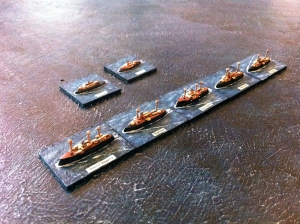
The ships are interestingly based on plastic Games Workshop cavalry slotta bases, 25mm x 50mm. This does make it a bit easier to pick them up. The water is cleverly printed from a picture of actual ocean printed in color! The wakes were painted on with white, and look quite realistic, IMHO.

The rules were a modified version of Brian deWitte's "When Dreadnoughts Ruled the Seas". Brian is a great guy and Dave the host had met him at a game he through at Historicon several years ago.  The rules are a good balance of crunchy and abstraction. Dave modified it for hexes and a bit more simplification of gunnery and a couple other things. For an occasional game on a weeknight, it was tough for some of the non-naval buffs to follow. In my opinion, game periods that rely on technical ability are tough to get right: the balance of technical differentiation makes the ships and period what it is, but players get confused by the arcane terminology.

Overall, the game was fun, but a bit too streamlined for me - I like naval games to be plenty crunchy, as that gives them good feel.  I don't like detail for detail's sake, or just to prove we know something. Details need to fit into the command level of the game, and illustrate critical differences in ship design and crew quality. But if it gets too simple, it may be tough to notice what period it is at all, which is not what I'm after..."a battleship is a battleship is a space battleship is an aeronautical battleship..." etc.

Just looking at these pics has me checking out my old Spanish-American war project. I like the boutique nature of the Avalanche Press naval games, they fit into a small space and don't take that long to play out. The abstraction does remove the maneuvering details, but replaces it with a "leadership skill" test that determines if one will fight at close or distant ranges.  That was a neat design trick. I may have to pull those out of a box at some point soon!

So...we'll see what happens next time, Adm. Togo!  Meanwhile, I toast you with the last of the *unbroken* vodka as the ship tilts slowly on its side...

Saturday, February 15, 2020

Forged in Battle 1:3000 fleets hit the streets! Well..."Hit the waves!"

Alexander Hay-Whitton, a South African based in Bangkok has corresponded re: the Forged in Battle review posted here [CLICK]. We went back and forth a few times and I cajoled some extra commentary and pics from him. This is undoubtedly what the FiB sculptor wants to see, so, enjoy!


"The first outing for the Forged in Battle Trafalgar fleets. I finished them yesterday [he did it in a month...I'm envious!]. They look pretty good, even with my less-than-renaissance brushwork.

The rules in question are 'Rum, Buggery, and the Lash', trying to do a sort of DBA for sailing fleets, since I don't think the usually massed record-keeping ruleset suits local conditions. 

Less than glorious, it was a disaster! The rules actually penalized the fleet with more frigates, and we ended up starting way downwind. There were also numerous opportunities for the sort of gamer who plays the loopholes rather than the game.... I need to do a lot to the rules before we try again!"

lovely overview with an island or peninsula to left


"The cloth representing the ocean is cheap Chinese silk (Thai silk is better, but would be wasted on such a project)."


Very nice building models - must ask what they are!

View from the crow's nest - sails ahoy!


maneuvering for a positional advantage but it seems blocked!

things are looking pretty scrappy here

***********************************

"Since then, we've had another, much more successful go, following a lot of rule revisions."

"Too Geometrical"


"This second time we brought off a Nelson act, coming in from windward and cutting an enemy squadron in half, beating it down with a full squadron's fire, boarding, and capturing five SOL before nightfall." 

"Break the line!"

Wild melees above and below!

"We also landed some 2mm Irregular Miniatures marines and captured the land battery."


"S. Valentine is captured!"

Players were myself (Nelson), my wife Krisanan (Collingwood), and my regular opps Anthony Reardon (Villeneuve), and Englishman, and Mike Seely (Don Miguel da Siljio), a Canadian.

Rough being a wargaming Alexander, isn't it? Gives you a lot to live up to!

******************************

Yes, but Alexander wasn't much of a naval commander, anyway, altho some say he was "at sea" mentally!

Well, that's all for now - Alex's work is inspiring me to get back to these ships and playtest the rules I was favoring, Bob Cordery's Portable Naval Wargame. The rules and many others are a free download here [CLICK].

Wednesday, February 27, 2019

Pre-dreadnought Project, p.5: 1:3000 Assembly, cleaning

1:1 Ship model - farther along than mine, but it took ten years or so...
Image result for pre dreadnoughts
Nice image from this great post at video game forum: [CLICK]

Whew! First post since November, 2018. Things have been super-busy but 2019 is hopefully going to be a lot calmer with only a couple of major projects with the family and a lighter work schedule, overall. TY2020 is scheduled to be VERY light so the 1:1 Army will not be too bad, and I just have to await what God does with pastoral work to see how busy I will be or not be. Hopefully, there'll be lots of time connecting with my immediate family and spending time with my almost 10yo who is getting very very active! In any event, this project was from late spring / early summer of 2018, and I hope to get these painted up and experiment with masts, fighting tops and a little rigging.

The Italian squadron, below. I've doubled down on Italia and Lepanto on the fictional assumption that Italy had the desire and resources to produce additional ships. Next to them are the plastic fighting tops. Overall, smaller is better for these, and if one has to err in a certain direction, get the smaller ones instead of the larger ones.

As noted before, these lovely little white metal ships are from Wartime Journal's now extinct metal line of 1/3000 ships. As they are totally gone, there's no point in a review. However, it should give you an idea of the kind of work done there and more confidence in the line of 3D plastics that are rapidly being produced [and which continue to be a sore tempation for me!].

My wargame tendancy for 1/3000 is to have squadron battles using variations of Portable Wargame rules, so groups of 3-4 ships are most suitable. I can also pair them into small "squadrons" of two ships each for games where extra players show up. The balance of captain business - allocating resources of crew, steam, and navigation - is what I find players to be most interested in, so 2-4 ships is just fine. Also, fighting squadrons per player instead of just a ship or two gives some space for lucky shots and accidental blowups.


Another view. Casting was excellent, but there's a bit of flash spiraling off the area where I supposed the metal is injected into the mold. Note that the plastics don't have any flash.


1/3000 ships are available from several sources, so altho I don't have any intent to add to this project at this time, the possibility is always there. Top view shows the interesting layout of the Italian ships. Altho the guns are supposed to be able to fire nearly 180 degrees, in practice the muzzle blast made this very difficult, so I'd probably restrict the ship to a much smaller angle, say 120 or something, just to differentiate in a rule set.


Flash removal was performed with a sharp X-acto blade, bracing the ship against a wooden ruler. Despite the cutting, there was still a bit left upon the stacks that had to be smoothed with a file. Still, this was just a few minutes of work per ship.


This "q-tip" appearing thingamabob is actually a bit of soft-sanding material on a plastic blue stick. I used it to gently rub off the mold lines and such. For some of the ships, they actually had a deck line halfway down the hull, so it may not be a flash line at all.


The four Big Ships, 2 x Italian class, 2 x Lepanto class [really, the same class, same designer, Benedetto Brin]. These are larger and easier to clean up.


The four smaller ships. Calabria PC [CLICK], cruiser Dogali [CLICK], 2 x Etna-class Protected Cruiser [CLICK]. The selection was based upon availability from WTJ. However, all four of these ships were similarly armed and could easily be a squadron with identical stats, or differentiated for more individualized play in a game. 

The nice thing about the pre-dreadnought era is that so many ships were singular, even eccentric and quirky in their design and even maintenance, that any amount of individuality can be argued as historically accurate! Let's here it for creativity and imagination: "huzzah!"

Some interesting model comparisons from the Italians to the Spanish Squadron, BELOW. 

The three Italian Giuseppe Garibaldi Armored Cruisers are only a minor stretch of history. The Italians built ten which went to four countries [CLICK]. The Cristobal Colon was delivered to Spain [CLICK] but Pedro de Aragon was cancelled, and certainly one or two could've been acquired or loaned from Argentina during the occasional Spanish naval panics of the 1890s. The Pelayo [tilted on the file] is an early pre-dread BB design [CLICK]. It's a French design with some tumblehome, and the most powerful ship in the Spanish navy; some argue that had she and Armored Cruiser Carlos V entered action during the Spanish-American war the history might be different [insert grain of salt here].

Some flash sticking out of the ends or various deck projections of the ships. Easy removal.

Below, torpedo-boats, destroyers, who can tell? Tiny ships that can be a pain to work with but useful on the tabl. They can also be fought as squadrons or individuals on the table, depending on player numbers, so these little guys add a lot of flexibility to a host's game. All you need is two sets of player aids on hand. 

Here, they are being gently scrubbed down with a soft toothbrush and mild dish soap, removing any release agent from the ship. Note that these have no mold, flash or other bits to be removed.

Note that these really need to be mounted on something for ease of handling, not to mention speed of painting!

Drake - Class cruisers below [CLICK]. From about 1902, they are really at the tail end of the project, but provide a glimpse of the future. Their 23-knot speed and 9" and 6" guns offer some variety in tactical play that will presage WWI choices. For gaming, a bit of variety in speed, gunnery and armor provides players with different challenges on the table. I see these operating similarly to the WWI British and German battlecruisers in my earlier fictitious Mediterranean naval flare-up!

Flash was not too bad, similar to that of the Italian BBs, and the mold lines actually appear to be almost natural. Big pic from Wiki shows a bit of shadowing there. Can't remember if I sanded them down at this point or not, but you get the idea. Internet pics are definitely our friend when it comes to working on these little guys.

Well, there you have it - a long wait for this post to go up, I think the pics are from June 2018. Just putting up the post makes me want to get moving again on this project. The question is who should fight whom first? Italians v. French for ownership of Sardegna? Spanish v. Italians over the Baleric Islans? Hard to say, but stay tuned!

Thursday, July 12, 2018

Review: Forged in Battle 1:3000 Age of Sail Ships

After quite a bit of searching around, I decided to pull the lanyard on these 1:3000 ships by Forged in Battle [CLICK] where five sets are presently offered: 
  1. both sides Battle of the Nile, 
  2. Copenhagen British, 
  3. Copenhagen Danish, 
  4. Trafalgar British, 
  5. Trafalgar Allies. 
There is interesting variety in the ships, the sail settings, the type of vessels, etc. The ships are also available in smaller batches "Squadron Packs" of 5 [4 if First Rate] for £8.00. At about $2.00 a ship that's not much hardship to bear, altho it doesn't cater to the whim of gamers who like to purchase ONLY and EXACTLY what they want. Think of it as buying strips of 6 or 10mm figs - you don't buy them in singles, but in batches. Enough said!

After some thinking, I decided to go for the Trafalgar British.


ORDERING & ARRIVAL. The package was easily ordered Forged in Battle's on-line site which was reasonably efficient and - worked. The packaged arrived in about 6 days or something amazing like that - I usually don't get domestic wargame merchendice that quickly [except from a few people like Neal Catapano at the War Store]...fantastic!


PACKING. the packing was about 50 feet [it seemed] of bubble wrap and could've brought fine china from the UK safely - the package was one blister with some foam [the usual] with all the ships in it. Sound a bit dicey? Well, these ships are as durable as the real thing!


CONTENTS. My package was:

7 x NAP12, 1st / 2nd Rate
17 x NAP13, 3rd Rate
3 x NAP14, small 3rd Rate
4 x NAP15, Large Frigate
31 Total ships
Unfortunately, I somehow missed separating out the 3 "Small 3rd Rate" shpis, and they are with in the middle group below [quite hard to tell apart, really].

Let's face it - this is a lot of ship for the money! In essence, it is 1/2 of Trafalgar - and most rules have options for small ship actions of a couple per side, or per player, so one could be finished with all Age of Sail purchases in one go here, and have everything from single-ship combat to good-sized squadrons of 15-16 ships!

THE GOODS. And below is what you've been awaiting, the closeup:


To left, NAP12 1/2 Rate. To right, NAP15 Large Frigate. In the center is a 3rd Rate of some sort. The metal between the fore and main masts is an identification streamer / flag, that between the main and mizzen is a bit of flash.  The pegs are for the included bases.

Note that even with a casual pic, you can see lots of little details, from the gunports to the ratlines, to the stern decorations, and these ships are...ONE INCH LONG! AMAZING!!!

comparison shots with vessel drawings from "Warfare in the Age of Sail" by B Ireland.

I think the proportions on the sculpts compare quite well - to these drawings, anyway.


Close comparison of 1st / 2nd Rate and diagram


Close pic of 3rd Rate 2-decker


Finally, the "large frigate" compared to diagram.

Overall, I think these ships capture the feel quite well, with good lines. My photography and the lighting isn't ideal, but I hope you can see how they look - remember, they're only one inch long, so of course they are more intended for squadrons together on the table.

Same three ships, stern view.


Same three ships, bow view - nice lines, you can see the bowsprit coming at you.


For comparison, below are my Wooden Ships and Iron Men counters, from the classic [and elderly, mine is a 1982 second edition] Avalon Hill board game. The counters are an inch by a 1/2 inch. Note that the bases are nearly the identical size. The holes are for the pegs, but one can certainly not use the bases at all. This is very convenient - I will most likely not use the bases as I'm thinking of using plexiglass instead so the ships always match the cloth.


Note how the ratlines provide additional stability to the masts without weighing down the sculpt visually. They are in fact solid, but I hope to hide that somewhat with the painting,  putting that "into shadow" or something. Pic shows off the "full sail" of these British ships, which are clearly working to close in on the Allied Fleet during the chase preceding the battle. Interestingly, the Allied ships have a different sail setting.

And below, a 1.5" hex map from Chessex. Nice fit, the ships look quite natural if a bit close together - they should really be a hex or two apart - a ship length or two.


Same, lower view. Note that the AH counters match the miniatures.

And here they are in Line Ahead, coming straight at you! Obviously, this upset the photographer and he failed to focus properly.

And below is the same on the WS&IM hex map. These ships just fit into the game "as-is" which just can't be a coincidence. Surely the sculptor has this game...? Below them are the same size counters from Avalanche Press' "1898" to show you what pre-dreadnoughts look like next to these lovelies - they look quite flat!


Overall, I give Forged in Battle:

- Customer service, packaging and shipping, A+
- Sculpting, sturdiness, proportions, A
- completeness of line, price, A++
- handiness and usefulness in games from convention to small table, A+
OVERALL RATING = A+

"Don't be stupid be a schmarty - Come and join the Forged in Battle Party!"


If you're looking for a great deal on sturdy ships with lots of visual appeal, excellent proportions at a great price, look no further. 37 years of gaming, these are some of the best thought out and executed sculpts I've ever seen. The "battle packaging" is great and will save newbies time and trouble with gathering models. And of course, the price...!!!


Future thoughts. well, obviously I'm going to get more. Certainly I want some variety in sail setting, ship, type, etc, so I'm seriously checking out the British fleet at Copenhagen, as well as the Danish. But, frankly, my future intent is to own ALL of these blisters!


Thursday, June 14, 2018

Pre-dreadnought Project, p.4: Painting 1:3000 Fleet

These fleets have more possible color schemes than the typical 
"variations on grey" of later periods
Related image

Well, I want to paint this stuff up quickly and be able to easily discern the squadrons from each other, so here's the scheme:


Clean and prep the pewter...white spray paint primer [they're tiny, need bright colors].

The following schemes to differentiate the Mediterranean squadrons, which are from War Times Journal and Fighting Fleets. I've tried to provide some pics so that one can see how the schemes look and decide if they have visual appeal.

Quick Thought:
It should be kept in mind that it is always possible to differentiate nationalities from one another by tonal variations, e.g. not all ochre is the same color. A darker ochre may ground a white ship better to the viewer, while a lighter ochre will help brighten up a black-hulled ship. As much of these details are unknown, I feel it is better to err on the side of artistry and easy of play than worry about the nitty gritty of possible tonal shades weathered by the Adriatic through a misty season! 

Also, paint was not nearly as sophisticated as today, and would show up with variation by manufacturer, be applied differently by different authorities, weather badly, and may very well not have a uniform standard conscientiously applied.

The purpose of the below pics is not just to provide some [possible] historical paint schemes, but also just to show what certain color schemes look like. This may help the artistically committed gamer decide on paint schemes where there is little evidence! Also, most of the images have links which may well provide a source for further ship images and information.

First a comparison image of a few different paint schemes:


Spain
Peacetime: Most black hull, white superstructure , ochre funnels.
Some light vessels had all white hulls & superstructure ochre funnels.
Wartime: No special wartime colors are known.
                - “FIGHTING FLEETS”: unknown [!?]
 
Peacetime: black hull, white superstructure & turrets , ochre funnels and masts. The black hull often had a narrow white band just below its upper edge, all the way around the ship. Sometimes (rarely, seen once on HMS Nile) the black was carried up onto the upperworks as high as the edge of the spar deck, making the turrets black instead of white.
Ships on tropical station would usually have white hull, superstructure or ochre superstructure, and ochre funnels.
Wartime: Dark Sea Grey (991) all over (except maybe lifeboats, white with brown wash on top).
 Image result for british pre dreadnought ships

France
Peacetime: black hull, upperworks and funnels either silver grey (883) or ochre (913).
Boundaries between hull and upperworks colors tended to vary widely, some placed very high on the ship at spar deck edge, and some lower at main deck edge.. Best to find photos of actual ships.
Wartime: Unknown, probably a Dark Sea Grey (991) or Medium Sea Grey (870) all over. Some sources say French ships have distinct greenish grey, which is supported by some builder's models still in existence.
                - “FIGHTING FLEETS”: black hulls, white upperworks, black funnel tops, DD lt. 
                 grey, subs sea green
Related image 

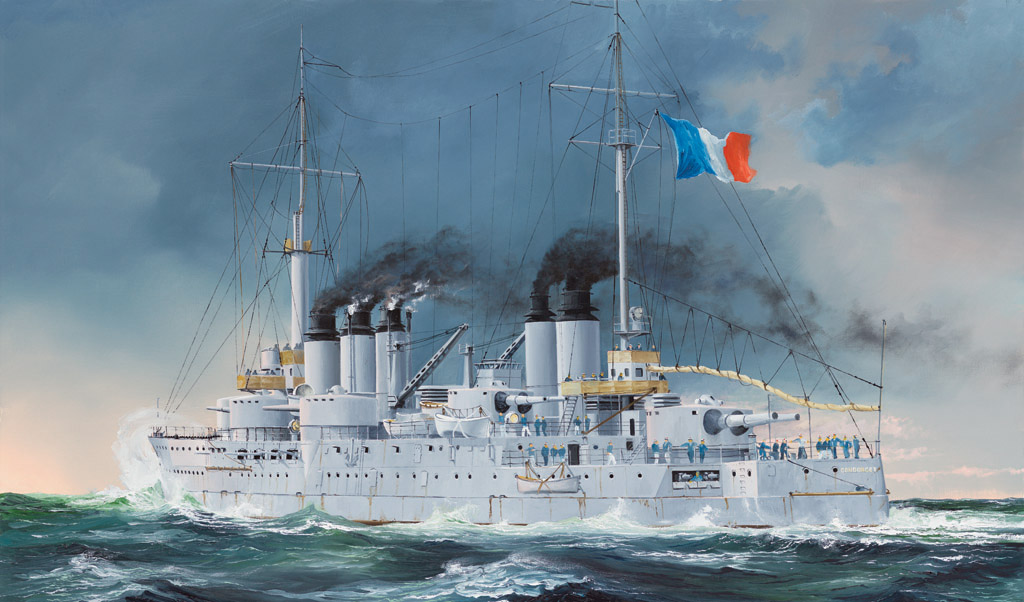
French battleship Masséna 1898 1:250 cardboard model
French Cruiser Jeanne d'Arc by Kara-ALVAMA
French battleship Iéna 1896 1:200 cardboard model

Italy
Peacetime: Typically black hull with white or Silver Grey (883) upperworks. The transition between black and white could be along the edge of the main deck, or sometimes down the middle of the amidships bulwarks/casemates.
The funnels and masts were commonly painted ochre, and in some cases - such as vessels like Italia or Andrea Doria - the lower half of the funnels would be white and the upper half would be ochre.
In vessels with super-heavy guns, the gun barrels were sometimes painted black or dark grey.
Wartime: Unknown, probably Dark Sea Grey (991) all over.
                - “FIGHTING FLEETS”: Dark Grey
Austria
Peacetime: As with other European fleets, a black hull with white or Silver Grey (883) upperworks and funnels. Unlike the rest of the upperworks and funnels, the ventilators, gun barrels and masts were commonly painted black like the hull. Turret tops seemed to be dark grey.  
Wartime: Reported by Jane's as being Sea Green. The best combination for this seems to be a 1:1 mixture of Medium Sea Grey (870) and Grey Green (866), although straight Grey Green also works while giving a greener but darker appearance.
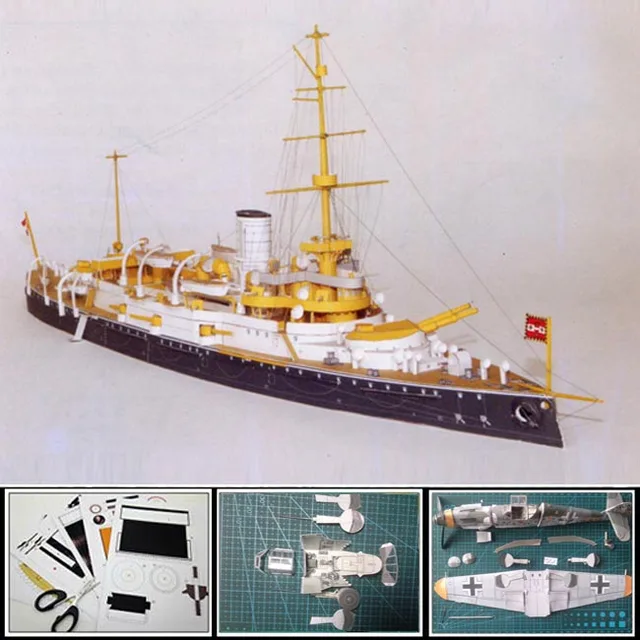
3D Paper Model Battleships Austrian-Hungarian battleship WIEN 1:400 scale 40cm Long 3d puzzles toy model papercraft for adult
https://www.aliexpress.com/item/Free-shipping-Paper-Model-Battleships-Austrian-Hungarian-battleship-WIEN-1-400-scale-40cm-Long-3d-puzzles/1116415373.html


** below is from War Times Journal, always worth checking out for free rules, and the latest Rapid Prototyped Plastic ships!** 
http://www.wtj.com/store/index_paint_guide_hist-paint.html

Painting
A great variety of color schemes was used on warships between 1885 and 1918, but in general these schemes tended to use similar basic colors. Many fleets used bright color schemes for peacetime and more drab color scheme for wartime. Peacetime colors tended to be black, white, light grey and/or ochre. Wartime colors were usually some shade of grey as were most vessels after 1905. Below is a table of the colors we use to paint WTJ fleets, followed by more nationality-specific outlines. 
Paint Type
Usage
Manufacturer
Number
Color
General Notes
Vallejo
951
White
Common lifeboat color
Vallejo
950
Black


Vallejo
862
Black Grey

Vallejo
870
Medium Sea Grey

Vallejo
991
Dark Sea Grey

Vallejo
992
Neutral Grey

Vallejo
883
Silver Grey

Vallejo
913
Yellow Ochre

Vallejo
967
Olive Green

Vallejo
866
Grey Green

Vallejo
821
German Beige

Vallejo
872
Chocolate Brown

Vallejo
898
Dark Sea Blue
Used to paint sea texturing for bases
Vallejo
540
Matte Medium (primer)
Used as undercoat for paint
Vallejo
520
Matte Varnish (sealer)
Used to seal painted ship
Vallejo
510
Gloss Varnish (sealer)
Used to seal textured base
Vallejo
400
Plastic Putty
Used for sea texturing model base
Citadel Colours
61-17
Bleached Bone
Good deck color, but discontinued
Vallejo (custom)
-
Buff & Silver Grey
Custom deck color: x2 parts buff, x1 part silver grey